Whop vs Stripe 2026: Real Cost Comparison
23 min read · Updated May 2026
Should I use Whop or Stripe to sell digital products?
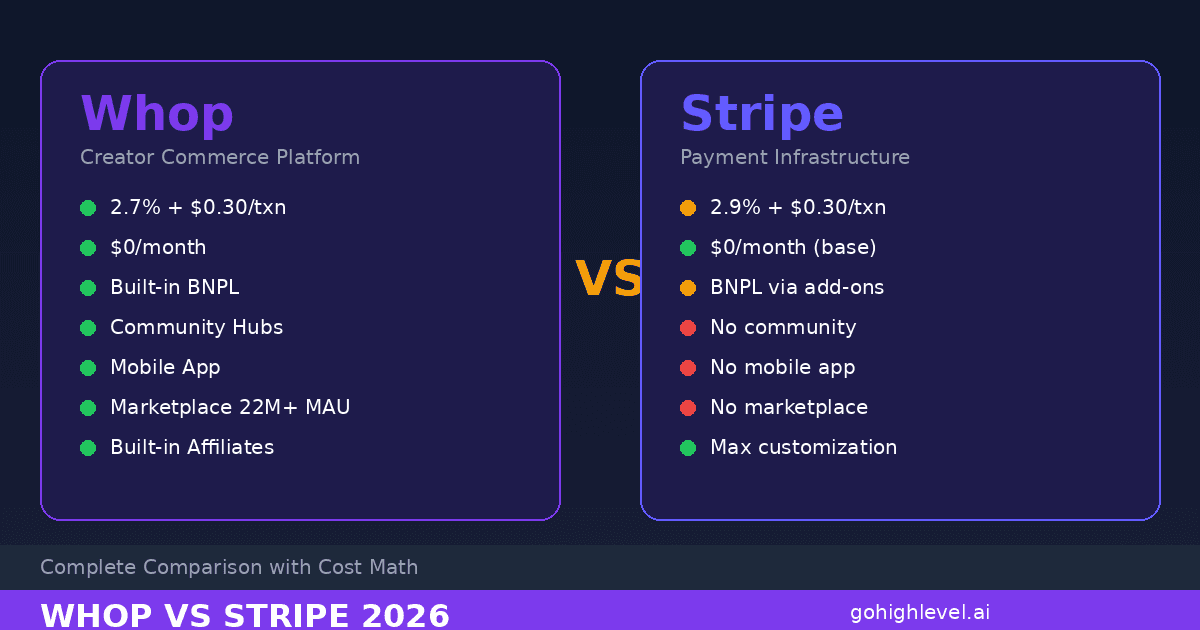
Whop is better for most digital product creators because it bundles checkout, BNPL, community, a mobile app, marketplace discovery, and affiliate management for $0/month with a 2.7% + $0.30 per transaction fee. Stripe is better for developers who need maximum payment customization or businesses processing $500K+ annually with engineering teams that can build custom checkout experiences. The real cost difference is not in the transaction fee (Whop is actually lower at 2.7% vs Stripe's 2.9%) but in the $200-500/month of additional tools you need on top of Stripe to match what Whop provides out of the box.
Whop and Stripe are not the same category of product, and that is the first thing most comparison articles get wrong.
Stripe is payment infrastructure. It processes transactions. It gives developers APIs, SDKs, and building blocks to construct custom payment experiences. What you build on top of Stripe is your responsibility.
Whop is a creator commerce platform. It processes transactions, yes, but it also handles BNPL through Whop Pay, hosts communities through Hubs, delivers courses, provides a native mobile app, runs a marketplace with 22M+ monthly active users, and manages an affiliate program. It is the entire stack in one product.
Comparing them directly is like comparing buying lumber versus buying a finished house. Both get you shelter, but the effort, cost, and timeline are radically different. This comparison covers both options with real cost math so you can make the right decision for your specific situation.
EXTENDED FREE TRIAL
Start with 30 days free, not 14.
Use our partner link to get double the standard 14-day trial.
Start Your Free 30-Day Trial →The Core Difference
Stripe sells payment processing. You get world-class APIs, extensive documentation, and the flexibility to build anything. But "anything" requires engineering time, additional tools, and ongoing maintenance. Stripe does not host your content, build your community, provide a mobile app, or help customers discover your product.
Whop sells a complete commerce platform. You get checkout, BNPL, community, content delivery, a mobile app, marketplace discovery, and affiliate management. The tradeoff is less customization. You use Whop's checkout flow, Whop's community structure, and Whop's marketplace. For most creators, that tradeoff is a net positive because the platform handles everything they would otherwise need to build.
The decision framework is simple:
- If you are a developer or have engineering resources and want maximum control over every aspect of the payment experience, use Stripe.
- If you are a creator selling digital products and want to launch quickly with integrated commerce, community, and discovery, use Whop.
- If you need both (maximum marketing automation plus integrated commerce), use Whop for commerce and GoHighLevel for marketing.
Transaction Fee Comparison
The fee comparison is straightforward and actually favors Whop:
| Whop | Stripe | |
|---|---|---|
| Domestic transaction fee | 2.7% + $0.30 | 2.9% + $0.30 |
| Monthly platform fee | $0 | $0 (base) |
| BNPL | Included (Whop Pay) | Klarna/Afterpay add-ons |
| International cards | Local acquiring in US/CA/EU/UK/AU | +1.5% cross-border fee |
| Recurring billing | Included | Included |
| Invoicing | Not applicable | Included |
| Connect (marketplace) | Not applicable | 0.5% + Connect fee |
On a $100 domestic sale:
- Whop: $3.00 (2.7% + $0.30)
- Stripe: $3.20 (2.9% + $0.30)
On a $500 domestic sale:
- Whop: $13.80 (2.7% + $0.30)
- Stripe: $14.80 (2.9% + $0.30)
On a $1,000 domestic sale:
- Whop: $27.30 (2.7% + $0.30)
- Stripe: $29.30 (2.9% + $0.30)
At every price point, Whop's per-transaction cost is lower than Stripe's standard rate. The 0.2% difference compounds: on $100,000 in annual revenue, that is $200 in savings on the transaction fee alone before considering the additional tools Stripe requires.
The exception: Stripe offers negotiated enterprise rates for high-volume merchants. If you process $500,000+ annually and negotiate a custom Stripe rate below 2.7%, Stripe becomes cheaper per transaction. But this only applies to merchants with the volume and leverage to negotiate, and the engineering cost of building the platform stack around Stripe still needs to be factored in.
The Real Cost: Total Stack Comparison
Transaction fees tell only part of the story. The real cost comparison is the total annual cost of running your business on each platform, including all the tools you need to match the functionality.
At $25,000/year revenue (early creator)
Whop stack:
- Whop: $0/month + 2.7% + $0.30 per transaction
- Transaction cost: ~$675 + $0.30 x transactions
- Community: Included (Hubs)
- Mobile app: Included
- Affiliate management: Included
- BNPL: Included
- Total annual cost: ~$750-850
Stripe stack (to match Whop's features):
- Stripe: $0/month + 2.9% + $0.30 per transaction
- Transaction cost: ~$725 + $0.30 x transactions
- Course/membership platform (Teachable Basic): $39/month = $468/year
- Community platform (Circle/Skool): $49-99/month = $588-1,188/year
- Affiliate platform (FirstPromoter): $49/month = $588/year
- Mobile app: None (would need custom build)
- BNPL: Additional Klarna/Afterpay fees
- Total annual cost: ~$2,400-3,000
Difference: Whop saves $1,600-2,200/year at $25K revenue.
At $100,000/year revenue (growing creator)
Whop stack:
- Transaction cost: ~$2,700 + $0.30 x transactions
- Everything else: Included
- Total annual cost: ~$3,000-3,200
Stripe stack:
- Transaction cost: ~$2,900 + $0.30 x transactions
- Teachable Pro: $119/month = $1,428/year
- Skool community: $99/month = $1,188/year
- Affiliate platform: $99/month = $1,188/year
- Mobile app: $0 (still none) or $5,000-10,000/year (custom)
- Total annual cost: ~$6,700-7,800 (without mobile app)
Difference: Whop saves $3,500-4,600/year at $100K revenue.
At $500,000/year revenue (established creator)
Whop stack:
- Transaction cost: ~$13,500 + $0.30 x transactions
- Marketplace commission: 30% on marketplace-sourced sales (varies)
- Everything else: Included
- Total annual cost: ~$14,000-18,000 (depends on marketplace-sourced mix)
Stripe stack (with negotiated rate):
- Transaction cost at 2.5% negotiated: ~$12,500 + $0.30 x transactions
- Kajabi Pro: $199/month = $2,388/year
- Circle/Skool: $99/month = $1,188/year
- Affiliate platform (Rewardful Business): $99/month = $1,188/year
- Custom mobile app: $10,000-20,000/year (maintenance)
- Total annual cost: ~$17,300-27,300
At $500K, the gap narrows. Whop is still competitive if most sales come through direct traffic (no marketplace commission). If marketplace-sourced sales are a significant portion of revenue, the 30% commission increases Whop's effective cost. But remember: marketplace sales are incremental revenue from customers you would not have reached otherwise. The 30% is a customer acquisition cost, not a tax on existing revenue.
The Crossover Point
Whop is economically superior for most creators at all revenue levels up to approximately $500,000/year. Above that level, the comparison depends on:
- What percentage of sales come from the marketplace (marketplace commission applies only to marketplace-sourced sales)
- Whether you can negotiate a Stripe rate below 2.7% (requires volume and leverage)
- Whether you value the engineering time saved by not building platform features yourself
For the vast majority of digital product creators, Whop wins the cost comparison. The savings are largest for early-stage creators (60-70% lower total cost) and narrow as revenue scales, but never disappear entirely because the platform stack Stripe requires always costs more than $0/month.
Feature-by-Feature Breakdown
Checkout Experience
Stripe: Maximum customization. Stripe Checkout, Payment Links, or fully custom checkout flows with the Stripe.js SDK. You can build exactly the checkout experience you want with any design, any flow, any payment method configuration. The tradeoff is development time: building and maintaining a production-grade checkout takes weeks of engineering work plus ongoing maintenance.
Whop: Polished default checkout. Card payments, Apple Pay, and BNPL options on a clean, fast checkout page. Limited customization of the checkout flow itself, but the default is high-quality and converts well. Setup time: minutes, not weeks.
Winner for creators: Whop. The default checkout is good enough for most digital products, and the setup time difference is enormous.
Winner for developers: Stripe. Nothing matches Stripe's checkout customization depth.
Buy Now Pay Later (BNPL)
Stripe: BNPL available through Klarna, Afterpay, and other integrations. These are add-ons that require configuration and sometimes carry additional fees. They work well for physical products but were not designed specifically for digital product use cases.
Whop: Whop Pay is built into the platform specifically for digital products. BNPL on courses, SaaS subscriptions, coaching programs, and other digital products. Included in the base transaction fee with no additional configuration. Customers split payments into installments and get immediate access.
Winner: Whop. Native BNPL for digital products is a genuine differentiator. The conversion lift on high-ticket digital products is significant, and Whop Pay is included in the base fee.
Community and Content Delivery
Stripe: None. Stripe processes payments. You need a separate platform (Teachable, Kajabi, Circle, Skool, or a custom build) for content hosting, course delivery, and community.
Whop: Hubs provides chat rooms, content libraries, course modules, drip schedules, completion tracking, and gated access by purchase tier. Members purchase and access community content in one platform with no redirect and no separate login. The native mobile app gives members a dedicated experience.
Winner: Whop by default. Stripe does not compete in this category. The relevant comparison is Whop Hubs versus dedicated platforms like Skool (stronger gamification) or Circle (deeper customization). For integrated commerce plus community, Whop wins.
Mobile Experience
Stripe: No consumer-facing app. Stripe provides a merchant dashboard app for managing payments, but there is no member-facing mobile app. Your customers get whatever mobile experience you build yourself (usually none).
Whop: Native iOS and Android apps for both members and creators. Members browse products, access communities, consume course content, and make purchases from the app. Creators manage revenue, members, and community from their phones.
Winner: Whop. The mobile app is a significant competitive advantage that most creators undervalue during evaluation. In 2026, mobile-first access drives higher engagement and completion rates.
Marketplace and Discovery
Stripe: None. Stripe does not help you find customers. All traffic comes from your own marketing efforts: paid ads, SEO, social media, email lists, referrals.
Whop: Marketplace with 22M+ monthly active users. Your products are discoverable through search, categories, trending lists, and algorithmic recommendations. The default 30% commission on marketplace-sourced sales is a customer acquisition cost that only applies when the marketplace drives discovery. Direct traffic sales carry no marketplace fee.
Winner: Whop. Free organic discovery through a 22M+ user marketplace is a channel that Stripe fundamentally cannot offer. For creators who lack large existing audiences, the marketplace can be transformative.
Affiliate Management
Stripe: None natively. You need a third-party affiliate platform (FirstPromoter, Rewardful, TapFiliate) starting at $49-149/month, plus the integration work to connect it.
Whop: Built-in through the marketplace. Every Whop seller can promote other sellers' products. Tracking, attribution, and payouts are handled automatically. Default commission rate is 30% (customizable). For a detailed guide, see our Whop affiliate program analysis.
Winner: Whop. Integrated affiliate management eliminates a separate tool, a separate cost, and a separate integration.
Developer Tools and API
Stripe: Industry-leading. The most comprehensive payment API available with excellent documentation, SDKs in every language, extensive webhook events, CLI tools, and a testing environment that is best-in-class. Stripe's developer experience is the gold standard against which every other payment platform is measured.
Whop: Solid. The API at dev.whop.com covers product management, memberships, customer data, and transactions. Webhook events handle common commerce scenarios. SDK support is growing. Documentation is clear but lacks the depth of Stripe's library.
Winner: Stripe. This is Stripe's core competency and it shows. Whop's developer tools are functional and improving, but they are not in Stripe's league for complex integrations.
International Payments
Stripe: Global coverage in 40+ countries with local acquiring where available. Cross-border fees of 1-1.5% on international cards. Multi-currency support with automatic conversion. The most comprehensive international payment infrastructure available.
Whop: Payments in 190+ countries with local acquiring entities in the US, Canada, EU, UK, and Australia. Local acquiring eliminates cross-border fees in those regions. For sellers in supported countries, international card processing is at the same 2.7% + $0.30 rate as domestic.
Winner: Tie with context. Stripe has broader international infrastructure. Whop has lower base rates and eliminates cross-border fees in key regions. For most creators selling to US/EU audiences, Whop's international handling is excellent. For businesses with complex multi-region compliance needs, Stripe's deeper tooling wins.
Recurring Billing
Stripe: Stripe Billing is comprehensive. Usage-based pricing, tiered billing, prorations, trials, coupons, tax calculation, invoicing, and revenue recovery. It handles every billing scenario a SaaS product could need.
Whop: Subscription billing with plans, trials, coupons, and automatic renewals. Covers the standard recurring billing needs for creators. Less flexible than Stripe for complex usage-based or metered billing models.
Winner: Stripe for complex billing. Whop for standard subscriptions. If you need usage-based pricing, metered billing, or complex enterprise invoicing, Stripe is the right choice. If you sell standard subscriptions for courses, communities, or SaaS, Whop covers it.
When to Choose Whop
Choose Whop if you match any of these profiles:
You are a course creator selling online education with community access. Whop handles checkout, BNPL for high-ticket courses, content delivery, and community in one platform. The marketplace adds organic discovery.
You are a SaaS founder targeting the creator economy. Whop's marketplace gives you distribution. The webhook integration with GoHighLevel adds marketing automation and CRM capabilities that Whop does not include.
You want BNPL on digital products. Whop Pay is the best native BNPL for digital products. The conversion lift on high-ticket items is significant.
You want to launch quickly. Whop gets you from zero to selling in minutes, not weeks. No development required. No additional tools to configure.
You lack a large existing audience. The marketplace with 22M+ monthly users provides a discovery channel that supplements your own marketing.
You want to minimize monthly costs. $0/month means you pay nothing until you make a sale. For creators testing new product ideas, this eliminates the financial risk of launching.
When to Choose Stripe
Choose Stripe if you match any of these profiles:
You are a developer who wants maximum control over the payment experience. Stripe's APIs let you build exactly the checkout, billing, and payment flow you need. Nothing else offers this level of customization.
You sell physical products. Stripe integrates with shipping, inventory, and e-commerce platforms like Shopify. Whop is built for digital products only.
You process $500K+ annually and can negotiate a Stripe rate below 2.7%. The per-transaction savings at scale may justify the additional platform costs, especially if you already have engineering resources maintaining your stack.
You need complex billing models. Usage-based pricing, metered billing, enterprise invoicing, or multi-entity billing structures require Stripe's depth.
You need maximum international coverage. Businesses operating in 40+ countries with complex multi-region compliance requirements may need Stripe's deeper international infrastructure.
Migration Considerations
Moving from Stripe to Whop
If you are currently on Stripe and considering Whop, the migration path depends on what you have built on top of Stripe.
Simple Stripe Checkout or Payment Links: Straightforward migration. Recreate your products on Whop, update your checkout links, and redirect customers. Active subscribers can be migrated by creating matching subscription plans on Whop and running both platforms in parallel during the transition period. Cancel Stripe subscriptions as they renew on Whop.
Custom Stripe integration with webhooks and automations: More complex. Audit every webhook listener and automation triggered by Stripe events. Map them to Whop's webhook events. If you use GoHighLevel for marketing automation, update the webhook URLs from Stripe endpoints to Whop endpoints in your GHL workflows.
Stripe Connect (marketplace/platform model): Evaluate carefully. Whop's marketplace is structurally different from Stripe Connect. If you have built a multi-seller marketplace on Stripe Connect, the migration to Whop involves rearchitecting your seller onboarding and payout flow. This may or may not be worth the effort depending on your scale and how deeply Stripe Connect is embedded.
Historical data: Export customer records, transaction history, and subscription data from Stripe before canceling. Whop will accumulate its own reporting once active, but historical data from Stripe will not transfer automatically.
The recommended approach for most creators: run both platforms in parallel for 30-60 days. Direct new customers to Whop. Let existing Stripe subscriptions run out naturally or migrate them at renewal points. Once all active revenue flows through Whop, deactivate the Stripe integration.
Moving from Whop to Stripe
This migration is more involved because you are not just switching payment processors. You are replacing an entire platform stack. You need to separately provision:
- A course/membership platform (Teachable, Kajabi, or custom)
- A community platform (Skool, Circle, or Discord)
- An affiliate platform (FirstPromoter, Rewardful, or custom)
- A mobile experience (custom app or responsive web)
The total setup time is measured in weeks, not minutes, and the monthly cost increases significantly. Most creators move from Whop to Stripe only when they outgrow Whop's customization limits or when their billing complexity exceeds what Whop can handle.
Real-World Use Case Scenarios
Scenario 1: Solo Course Creator Launching First Product
Sarah has built an audience of 5,000 email subscribers and wants to sell a $297 online course on Instagram marketing.
On Stripe: She needs Stripe for payments ($0/month), Teachable for course hosting ($39/month), and a community platform like Circle ($39/month) for student support. Total monthly cost before any sales: $78/month = $936/year. She also needs to integrate Teachable with Stripe, set up email notifications, and configure student onboarding manually.
On Whop: She creates a product on Whop ($0 setup), adds course content to a Hub, and shares her checkout link with her email list. Total monthly cost before any sales: $0. Her first sale costs 2.7% + $0.30 = $8.32. Students immediately access the Hub with course content and community chat.
Winner for Sarah: Whop. No upfront cost, faster setup, and integrated delivery. She can invest the $936/year in ad spend or content creation instead of platform fees.
Scenario 2: SaaS Founder with Engineering Team
Marcus runs a project management SaaS with 2,000 paying customers at $49/month ($1.2M ARR). His engineering team has built custom billing logic including usage metering, annual contract discounting, and multi-seat licensing.
On Stripe: He has a deeply integrated Stripe setup with custom checkout, Stripe Billing for complex subscriptions, webhooks triggering provisioning workflows, and multi-currency support across 12 countries. His negotiated Stripe rate is 2.5% + $0.30. Annual payment processing cost: ~$30,000.
On Whop: Whop cannot handle his billing complexity. Usage-based metering, multi-seat licensing, and enterprise invoicing are beyond Whop's current subscription management. Migration would require simplifying his billing model, which would lose functionality.
Winner for Marcus: Stripe. His billing complexity requires Stripe's depth, and his volume justifies the negotiated rate.
Scenario 3: Coach Selling $2,000 Certification Program
Elena is a business coach selling a $2,000 certification program. She needs checkout with BNPL (the $2,000 price point creates purchase friction), a community for students, course delivery for certification modules, and affiliate management because her graduates promote the program to their networks.
On Stripe: Payment processing + Klarna BNPL configuration + Teachable Pro ($119/month) + Circle ($39/month) + FirstPromoter ($49/month) = $207/month in tools. She also needs to integrate four separate systems.
On Whop: One platform. Checkout with Whop Pay BNPL built in. Hub for community and course delivery. Built-in affiliate management for graduate referrals. $0/month. Setup time: under an hour.
Winner for Elena: Whop. BNPL drives conversion on her $2,000 program, and the integrated affiliate management turns graduates into revenue-generating promoters without additional tools.
The Best Stack for Most Creators
For the majority of digital product creators in 2026, the optimal stack is:
- Whop for commerce - Checkout, BNPL, community, marketplace, mobile app, affiliates
- GoHighLevel for marketing - CRM, email/SMS automation, funnels, pipelines, AI employees
- Webhooks connecting them - Setup guide here
This stack gives you integrated commerce with no monthly fee (Whop), world-class marketing automation starting at $97/month (GoHighLevel), and native connectivity between them. The total cost is lower than any comparable all-in-one platform, and each tool is best-in-class for its function.
Stripe remains the right choice for developers building custom commerce experiences, physical product sellers, and high-volume businesses with engineering teams. But for creators whose primary focus is creating and selling digital products rather than building payment infrastructure, Whop provides more value at a lower total cost.
Security and Compliance
Both platforms handle PCI compliance so you do not have to. Neither requires you to store credit card data on your own servers or manage your own PCI audit.
Stripe is PCI Level 1 certified (the highest level), processes billions of dollars annually, and has extensive fraud prevention tools including Stripe Radar with machine learning-based fraud detection. Stripe's security infrastructure is industry-leading and battle-tested at massive scale.
Whop handles PCI compliance for its merchants and processes payments securely. The platform is newer and processes lower total volume than Stripe, but security incidents have not been a public concern. Whop's fraud prevention tools are less sophisticated than Stripe Radar but adequate for the creator economy transaction patterns the platform handles.
For most creators, both platforms provide sufficient security. If your business has specific compliance requirements (SOC 2, HIPAA, enterprise security reviews), Stripe's more extensive compliance certifications and documentation may be necessary.
The Bottom Line
The Whop versus Stripe decision comes down to one question: are you a builder or a creator?
If you are a builder who wants to construct a custom commerce experience with maximum control over every detail, Stripe gives you the best tools available. You will pay more in total cost (transaction fees plus platform fees plus engineering time), but you will get exactly the experience you want.
If you are a creator who wants to sell digital products and focus your time on content, community, and marketing rather than payment infrastructure, Whop provides more functionality at a lower total cost. The 2.7% + $0.30 transaction fee is lower than Stripe's standard rate. The $0 monthly fee eliminates platform risk. The integrated BNPL, community, mobile app, marketplace, and affiliate management replace $200-500/month in separate tools.
For our full Whop review with scores across five categories, see the deep dive. For the recommended Whop + GHL integration stack, see the setup guide.
EXTENDED FREE TRIAL
Start with 30 days free, not 14.
Use our partner link to get double the standard 14-day trial.
Start Your Free 30-Day Trial →Frequently Asked Questions
Is Whop cheaper than Stripe?
Can I use Whop and Stripe together?
Does Whop have better BNPL than Stripe?
What is the 30% Whop marketplace fee?
Is Stripe better for SaaS billing?
Does Whop work internationally?
Can I negotiate Whop's transaction fees?
Which has better developer tools?
Should I switch from Stripe to Whop?
Does Whop have a mobile app?
Can I use Whop with GoHighLevel instead of Stripe?
Which is more reliable?
Ashley Kemp is a digital entrepreneur and perpetual traveller. Switched from ClickFunnels to GoHighLevel years ago and never looked back. Writing about what actually works.
Was this article helpful?