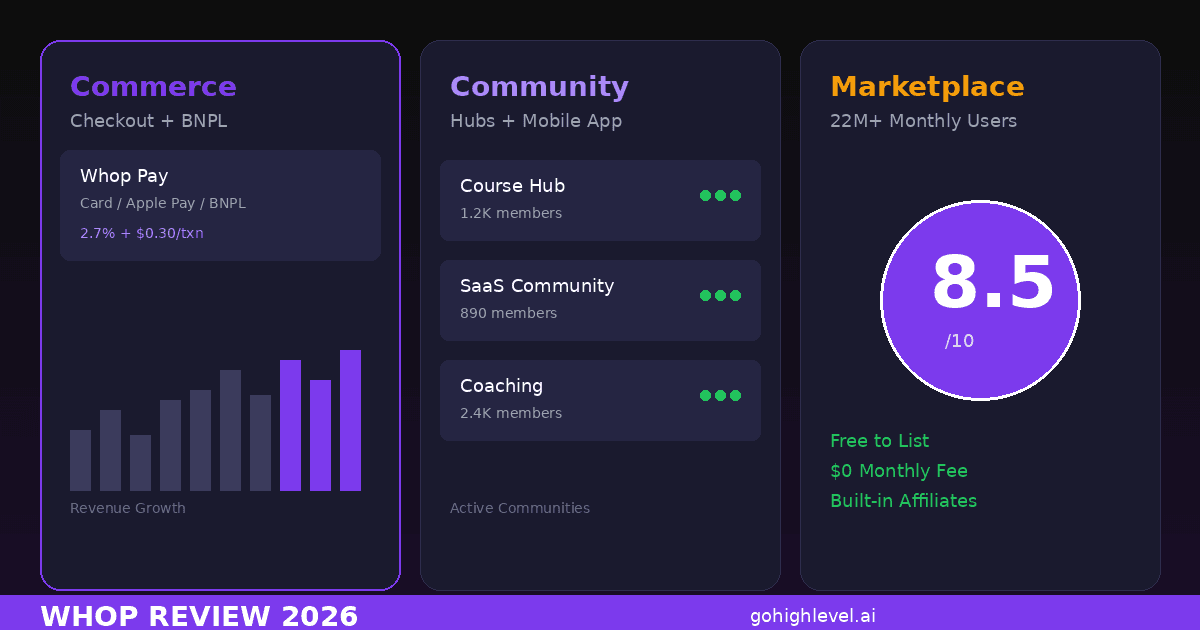
Whop has done something that most creator platforms talk about but never execute: it built the entire commerce stack into one product and made it free to start.
No $97/month base fee. No $297/month "pro" tier. No setup costs. You sign up, list your digital product, and start selling with a 2.7% + $0.30 per transaction fee that is lower than the industry standard. The platform handles checkout, buy now pay later through Whop Pay, community delivery through Hubs, a native mobile app for your members, and a marketplace with 22M+ monthly active users that surfaces your products to audiences you never would have reached on your own.
That combination is why Whop has become the default commerce layer for a growing segment of course creators, SaaS founders, and community operators. It is also why this review exists. After 11 months of selling both courses and SaaS through Whop, the score of 8.5/10 reflects a platform that is genuinely category-leading in several areas with real gaps that matter for specific use cases.
This is not a surface-level product tour. This review covers the commerce engine, the BNPL conversion dynamics, the community platform, the marketplace economics, the affiliate program, the developer integration surface, and the honest limitations that Whop's own marketing will never tell you about.
Is Whop worth it for creators in 2026?
Whop is genuinely worth it for creators selling digital products. The $0 monthly fee with 2.7% + $0.30 per transaction is economically competitive with any stack. Built-in BNPL via Whop Pay drives measurably higher conversion on high-ticket products. The native mobile app, Hubs communities, and a marketplace with 22M+ monthly active users create a platform that would cost $200-500 per month to replicate with separate tools. Best for course sellers, SaaS founders, and community operators. Less ideal for physical products, traditional B2B SaaS, or businesses needing maximum checkout customization.
Score Breakdown
What Is Whop?
Whop is a creator commerce platform that bundles digital product checkout, BNPL financing, community delivery, a native mobile app, and marketplace discovery into a single product. Founded by Steven Schoeffel and Cameron Zoub, the platform pivoted from its original app marketplace concept to become a full creator commerce stack during 2022-2023 and has scaled aggressively since.
The positioning is "everything you need to sell digital products" and for once, the marketing is close to accurate. Most creator platforms force you to choose: Stripe for payments, Teachable for courses, Skool for community, Gumroad for simple digital products, and then a separate affiliate platform to tie it all together. Whop consolidates that entire stack.
The key differentiators that separate Whop from the field:
Commerce layer with BNPL. Whop handles checkout with card processing, Apple Pay, and buy now pay later through Whop Pay. The BNPL piece is significant because it works on digital products, not just physical retail. High-ticket course creators see meaningful conversion lifts when customers can split a $997 purchase into installments.
Hubs for community. Whop Hubs is the platform's community and content delivery system. Chat rooms, gated content, course delivery, member management, all integrated with the commerce layer so members purchase and access everything in one place.
Marketplace discovery. The Whop marketplace has 22M+ monthly active users browsing and discovering digital products. For creators, this is a free organic traffic channel that supplements their own audience.
Native mobile app. Both iOS and Android apps give members a dedicated experience for browsing, purchasing, and engaging with communities. In 2026, this matters more than most creators realize because a growing majority of digital product consumption happens on mobile.
$0 monthly fee. The pricing model is transaction-based: 2.7% + $0.30 per transaction with no monthly fee, no setup cost, and no minimum revenue requirement. This removes the economic barrier that keeps early-stage creators from launching.
Info
Editor's Note: I came to Whop after running my course and SaaS businesses through a custom Stripe checkout connected to a separate membership platform and a Discord server for community. The stack worked, but managing three separate tools, three separate billing relationships, and the integration glue between them was consuming time I should have spent on content and product development. Whop clicked for me when I realized the BNPL conversion lift on my $497 course was paying for the platform fee multiple times over, and the mobile app gave my members an experience I could never have built on Discord. I switched my primary commerce layer to Whop about 11 months ago and have not looked back. That does not mean it is perfect. This review covers the genuine gaps alongside the genuine strengths. - Ashley Kemp
Deep Feature Analysis
Whop Checkout
The checkout experience is clean. Customers see card payment, Apple Pay, and BNPL options on a single page. The UI is modern, loads fast, and handles the purchase flow without unnecessary friction.
Subscription billing, one-time purchases, tiered pricing, free trials, and coupon codes are all supported. For creators coming from Stripe Checkout, the Whop checkout is comparable in quality but comes with the entire platform attached. You do not need to build a separate product page, membership gate, or delivery mechanism.
International support covers 190+ countries. Whop has local acquiring entities in the US, Canada, EU, UK, and Australia, which eliminates the cross-border fees (typically 1-1.5% extra) that international transactions carry on most payment processors. For creators selling to a global audience, this is a meaningful cost advantage that often goes unnoticed.
The transaction fee of 2.7% + $0.30 is lower than the standard 2.9% + $0.30 that Stripe, PayPal, and most processors charge for domestic card transactions. On a $100 sale, that is $3.00 on Whop versus $3.20 on Stripe. The difference compounds at scale, but more importantly, there is no monthly fee sitting on top of the transaction cost.
Where Whop's checkout falls short compared to Stripe: customization. Stripe lets developers build completely custom checkout experiences with full control over the UI, payment flow, and post-purchase logic. Whop gives you a polished default experience but limited ability to modify the checkout flow itself. For most creators, the default is good enough. For developers building highly custom commerce experiences, Stripe remains the better foundation.
Whop Pay (BNPL)
Buy now pay later on digital products is Whop's most underrated feature. Traditional BNPL providers like Klarna and Afterpay focus on physical retail because that is where the volume is. Whop Pay brings BNPL to courses, SaaS subscriptions, coaching programs, and other digital products where the price point is often high enough to create purchase hesitation.
The mechanics are straightforward. A customer buying a $997 course can split the payment into installments. They get immediate access to the product while paying over time. Whop handles the delinquency risk, which means the creator gets paid on the initial transaction and does not bear the collection burden if a customer defaults.
The conversion impact is real. High-ticket digital products are the category where BNPL matters most because the purchase decision is often emotional and time-sensitive. A potential student evaluating a $997 course may be convinced by the content but hesitant about the price. Offering $249 per month over four installments changes the framing from "Can I afford this?" to "Is this worth $249 per month?" The answer is almost always yes for a qualified buyer, and the conversion rate reflects that shift.
Where BNPL creates problems: it can attract buyers who cannot actually afford the product at any price point. Impulse purchases on installment plans sometimes lead to refund requests, chargebacks, or community members who are not invested in the material. Creators selling high-ticket products should pair BNPL with qualification steps (application forms, sales calls) to ensure the buyers who use installments are the right fit.
Whop Pay is also a competitive advantage over Stripe's BNPL integrations. Stripe supports Klarna and Afterpay through integrations, but they are add-ons that require configuration and often come with additional fees. Whop Pay is native, included in the base transaction fee, and designed specifically for digital product creators.
Whop Hubs (Community)
Hubs is Whop's community platform, and it is both the feature where Whop impresses and the feature where it falls short of the category leader.
What Hubs does well: integrated commerce. Members purchase a product and immediately land in the community hub with access to chat rooms, content libraries, course modules, and member directories. There is no redirect to a separate platform, no additional login, no friction between purchasing and participating. The commerce-to-community handoff is seamless in a way that Stripe + Discord or Stripe + Circle cannot match without custom development.
The content delivery within Hubs supports video hosting, text lessons, drip schedules, and completion tracking. For course creators who need a place to host and deliver their content alongside a community, Hubs covers both without a separate LMS tool.
The mobile app experience for Hubs is genuinely strong. Members open the Whop app on their phone, see their purchased communities, browse new content, participate in discussions, and access course materials. The native app experience is better than what most web-only community platforms offer and gives creators a "branded app" feeling without the cost of building their own.
Where Hubs falls short: Skool. The honest comparison is that Skool's gamification system with points, levels, leaderboards, and content unlocks drives higher daily engagement than Hubs does. Skool built its entire product architecture around the engagement problem, and it shows in the metrics. Members in Skool communities return more frequently, participate more actively, and build stronger habits around the platform.
Hubs is a solid community platform. Skool is an exceptional one. If community engagement is your primary metric and you are willing to pay Skool's $99/month fee for it, Skool is the better community platform. If you want commerce, community, and marketplace integrated into one product with no monthly fee, Whop's Hubs delivers more total value even if the community-specific engagement is lower.
Compared to Circle, Hubs wins on integrated commerce and mobile app experience. Circle offers deeper customization, richer branding options, and more flexible community structures, but it does not handle payments or product delivery natively. The choice depends on whether you prioritize commerce integration (Whop) or community customization (Circle).
Whop Marketplace
The marketplace is Whop's strategic differentiator and the feature that makes the platform genuinely different from Stripe, Gumroad, Teachable, or any other creator commerce tool.
With 22M+ monthly active users browsing the marketplace, creators who list their products gain access to an organic discovery channel that most platforms cannot offer. Potential customers browse trending products, explore categories, read reviews, and discover creators they would never have found through Google search or social media.
How discovery works: the marketplace surfaces products based on relevance, trending signals, ratings, and category fit. Creators who maintain high ratings, consistent sales, and active communities rank higher. The algorithm rewards quality over quantity, which creates a flywheel where good products get more visibility, which drives more sales, which drives higher ratings, which drives more visibility.
The economic tradeoff is the 30% default affiliate commission on marketplace-sourced sales. This is the most commonly misunderstood aspect of Whop's pricing. The 30% is not a platform fee on all transactions. It is the default commission rate for marketplace-sourced discovery, and you can customize it. Sales from your own direct traffic, email list, social media links, or direct checkout URLs carry no marketplace commission. Only sales where the marketplace (or a marketplace affiliate) drove the discovery trigger the commission.
The strategic decision for creators: should you list on the marketplace? In most cases, yes. The 30% commission on marketplace-sourced sales is essentially a customer acquisition cost. If you would otherwise spend 20-40% of revenue on paid ads to acquire the same customer, the marketplace commission is comparable or cheaper, and it requires no ad spend, no creative production, and no ongoing optimization. The customers come to you.
Where the marketplace creates tension: established creators with large existing audiences may not want marketplace exposure because the 30% commission on new sales that their own marketing would have captured anyway feels like an unnecessary cost. The solution is to direct your existing audience to your direct checkout link (no commission) and let the marketplace bring in net-new customers at the 30% rate.
Whop App (Mobile)
The native mobile app is one of Whop's strongest competitive advantages, and it is the feature that most creators underestimate during their platform evaluation.
The member experience on mobile is polished. Members download the Whop app, log in, and see all their purchased products, active communities, and available content in one interface. They can browse the marketplace for new products, make purchases with saved payment methods, access course modules, participate in community discussions, and receive notifications for new content or community activity.
For creators, the mobile dashboard provides revenue tracking, member management, community moderation, and analytics. The ability to manage your business from your phone is table stakes in 2026, but the quality of Whop's mobile implementation is above average compared to web-first platforms that treat mobile as an afterthought.
Why mobile matters for digital product creators: consumption patterns have shifted. A growing majority of course buyers browse and purchase from their phones. Community engagement peaks during commute times and breaks when members are on mobile. Creators who deliver their products through a native mobile app see higher completion rates on courses and higher engagement in communities compared to creators who rely on web-only access.
The mobile app also creates a retention advantage. A Whop community that lives on a member's phone home screen gets opened more frequently than a bookmarked website. The notification system keeps members coming back. The convenience of tapping an app versus navigating to a URL in a browser is a small friction reduction that compounds into measurably better engagement over time.
Developer API and Webhooks
Whop's developer surface is solid and well-documented. The API at dev.whop.com covers product management, membership access, customer data, and transaction history. The webhook system fires events for purchases, cancellations, refunds, and membership changes.
For creators who integrate Whop with GoHighLevel, the webhook integration is the connection point. When a customer purchases on Whop, a webhook event fires to your GHL workflow, which can trigger contact creation, pipeline updates, email sequences, SMS follow-ups, and any other automation in your marketing stack. We covered this integration in detail in our GoHighLevel and Whop integration tutorial.
The API documentation quality is good. Clear endpoint references, request/response examples, authentication guides, and SDK support for common languages. Compared to Stripe's industry-leading documentation, Whop's docs are a step behind in depth and breadth but are functional and improving consistently.
Third-party integrations through Zapier and Make are also available for creators who prefer no-code automation. The most common integration patterns connect Whop purchases to email marketing tools, CRM systems, and project management platforms.
Where the developer experience falls short: edge cases. Stripe has spent over a decade handling every conceivable payment scenario, and their API reflects that depth. Whop's API covers the common paths well but occasionally lacks the granularity that developers need for complex multi-product, multi-region, or multi-currency implementations. For most creator businesses, this is not a limitation. For enterprise-scale operations, it can become one.
Affiliate Program
Whop's affiliate program operates through the marketplace, which makes it structurally different from traditional affiliate programs.
In a traditional affiliate setup (like the GoHighLevel affiliate program), creators get a unique referral link, share it with their audience, and earn commissions on resulting sales. Whop's affiliate system works similarly but with a marketplace layer: creators can promote other Whop products, and when they drive sales through marketplace referrals, they earn the commission rate set by the product seller (default 30%, customizable).
The marketplace creates a built-in affiliate network where every Whop seller is a potential affiliate for every other Whop seller. This eliminates the need for a separate affiliate platform, affiliate link management, and payout processing. The system handles tracking, attribution, and payouts automatically.
For a deeper analysis of how the affiliate program works and strategies for maximizing affiliate income, see our Whop affiliate program guide.
Pricing Analysis
Whop's pricing is genuinely creator-friendly, and the structure is simple enough that there are no hidden costs to discover after you have committed.
Transaction fees: 2.7% + $0.30 per domestic transaction. This is lower than the industry standard of 2.9% + $0.30 that Stripe, PayPal, and most processors charge. No separate platform fee sits on top of the transaction cost.
Monthly fee: $0. No setup fee. No minimum revenue requirement. You pay nothing until you make a sale.
International transactions: Local acquiring in the US, Canada, EU, UK, and Australia eliminates cross-border fees. For sellers in these regions, international card transactions process at the same 2.7% + $0.30 rate as domestic ones. This is a meaningful advantage because cross-border fees on other processors typically add 1-1.5% per international transaction.
Marketplace commission: 30% default on marketplace-sourced sales (customizable). Only applies when the marketplace drives discovery. Direct traffic sales carry no marketplace commission.
Whop Pay (BNPL): Included in the base transaction fee. No additional cost for offering installment payments.
The Cost Comparison
To understand Whop's value, compare the cost of running a creator business on Whop versus the cost of the stack it replaces:
Whop on $50,000/year revenue:
- Transaction fees: $1,350 + $0.30 per transaction (at 2.7%)
- Monthly platform fee: $0
- Community platform fee: $0 (Hubs included)
- Affiliate platform fee: $0 (marketplace included)
- Mobile app cost: $0 (native app included)
- Total annual cost: approximately $1,500-1,800 (varies by transaction count)
Traditional stack on $50,000/year revenue:
- Stripe processing: $1,450 + $0.30 per transaction (at 2.9%)
- Teachable or Kajabi: $948-3,564/year ($79-297/month)
- Skool or Circle community: $1,188/year ($99/month)
- Affiliate platform (FirstPromoter, Rewardful): $588-1,188/year ($49-99/month)
- Mobile app: either $0 (no app) or $3,000-10,000/year (custom build)
- Total annual cost: approximately $4,174-7,590/year
The economic case is clear. Whop consolidates a $4,000-7,500/year stack into a transaction-fee-only model that costs $1,500-1,800/year at $50,000 in revenue. The savings increase as revenue scales because the traditional stack has fixed monthly costs that compound while Whop's percentage-based fee scales proportionally.
The counterpoint: at very high revenue levels ($500,000+/year), the 2.7% transaction fee may exceed what a custom Stripe integration with negotiated rates would cost. Enterprise sellers with the engineering resources to build their own checkout, membership, and community infrastructure can potentially reduce their per-transaction cost below Whop's rate. For most creators, this crossover point is theoretical because the engineering and maintenance costs of building that custom stack far exceed the transaction fee savings.
Info
Editor's Note: The pricing math is what convinced me to switch. I was paying $297/month for my course platform, $99/month for community, and $49/month for affiliate tracking before I even factored in Stripe's transaction fees. That is $445/month in fixed costs regardless of revenue. On Whop, my fixed cost is $0 and my transaction cost is lower than Stripe's standard rate. At my revenue level, the annual savings covered the cost of creating new course content. The 30% marketplace commission is the one area where costs can surprise you, but I manage it by directing my existing audience to my direct checkout link and letting the marketplace bring in genuinely new customers. The marketplace-sourced customers are incremental revenue I would not have earned otherwise, so the 30% commission is a customer acquisition cost, not a tax on existing revenue. - Ashley Kemp
Who Should Use Whop
Course creators selling digital products. If you sell online courses, workshops, coaching programs, or educational content, Whop provides checkout, BNPL, content delivery, community, and marketplace discovery in one platform. The zero monthly fee means you can launch a course without committing to platform costs before you have revenue.
SaaS founders targeting the creator economy. If your SaaS product serves creators, coaches, consultants, or online educators, Whop's marketplace gives you distribution to an audience that is actively looking for tools to grow their businesses. The webhook integration with GoHighLevel creates a stack where Whop handles commerce and GHL handles marketing automation.
Community operators. If you run a paid community and want commerce integrated with community access, Whop eliminates the gap between payment and membership. Members purchase and land in the community immediately with no redirect, no separate login, and no manual access provisioning.
Coaches and consultants selling productized services. If you have productized your coaching or consulting into courses, templates, frameworks, or toolkits, Whop handles the commerce and delivery while you focus on the content.
Affiliate marketers. If you promote digital products to your audience, Whop's marketplace affiliate program gives you access to thousands of products with built-in tracking, attribution, and payouts. No need to apply to individual affiliate programs or manage separate tracking links.
Who Should NOT Use Whop
Physical product sellers. Whop is built for digital products. If you sell physical goods, Shopify remains the clear leader with shipping integration, inventory management, and the infrastructure that physical e-commerce requires.
Traditional B2B SaaS. If your software serves enterprise customers outside the creator economy, Whop's marketplace audience and platform positioning will not align with your distribution strategy. Use Stripe for payments and build your own sales motion.
High-volume sellers needing maximum control. If you process $500,000+ in annual revenue and have the engineering team to build custom checkout experiences, Stripe's developer tools and negotiated enterprise rates may produce lower total costs than Whop's 2.7% + $0.30 transaction fee. This only makes economic sense if you can absorb the development and maintenance costs of the custom stack.
Businesses requiring complex multi-region compliance. While Whop handles international payments well, businesses with complex tax, compliance, or regulatory requirements across many jurisdictions may need the deeper tooling that Stripe, Paddle, or specialized payment platforms provide.
Companies needing deep CRM. Whop handles commerce and community but is not a CRM. For businesses that need pipeline management, lead scoring, email automation, and multi-channel marketing, pair Whop with GoHighLevel rather than expecting Whop to handle it alone.
Comparison to Alternatives
Whop vs Stripe
The most common comparison, and the most misunderstood. Stripe is payment infrastructure. Whop is a commerce platform. Stripe gives you the building blocks to construct a custom payment experience. Whop gives you the finished product.
Whop charges 2.7% + $0.30 per transaction versus Stripe's 2.9% + $0.30. But the real cost difference is not in the transaction fee. It is in the $200-500/month of additional tools you need on top of Stripe to match what Whop provides out of the box: course platform, community, mobile app, affiliate management, and marketplace discovery.
For a detailed breakdown with cost math and use case analysis, see our Whop vs Stripe comparison.
Whop vs Gumroad
Gumroad is simpler. If you want a basic digital storefront where you upload a file and collect payment, Gumroad gets you there faster. But Whop offers BNPL, community delivery through Hubs, a native mobile app, marketplace discovery, and built-in affiliate management. Gumroad offers none of those. For solo sellers with simple digital products (ebooks, templates, one-off downloads), Gumroad may be sufficient. For creators building businesses around courses, communities, or SaaS products, Whop provides substantially more infrastructure.
Whop vs Teachable
Teachable is a dedicated LMS (learning management system) with deeper course creation tools, student analytics, and learning path features. Whop's content delivery in Hubs covers the fundamentals but does not match Teachable's course-specific depth. However, Teachable charges $39-249/month while Whop charges $0/month. And Teachable does not include community, marketplace, mobile app, or BNPL. The choice depends on whether you need a dedicated course platform (Teachable) or an integrated commerce platform that includes course delivery (Whop).
Whop vs Kajabi
Kajabi bundles courses, email marketing, funnels, and a website builder into one platform starting at $149/month. It is the most direct competitor to Whop's all-in-one positioning. Whop wins on pricing ($0/month vs $149+/month), mobile app quality, marketplace discovery, and BNPL. Kajabi wins on email marketing (Whop has none), landing page building, and marketing funnel construction. If email marketing and funnels are core to your business, Kajabi or the Whop + GoHighLevel stack provides those capabilities.
The Verdict
Pros
- $0 monthly fee with 2.7% + $0.30 per transaction removes the pricing barrier that keeps creators from launching
- Whop Pay BNPL on digital products drives measurably higher conversion on high-ticket courses and SaaS subscriptions
- Native mobile app for iOS and Android gives members a dedicated experience that web-only platforms cannot match
- Marketplace with 22M+ monthly active users surfaces your products to new audiences as a free organic traffic channel
- Built-in affiliate program through the marketplace eliminates the need for separate affiliate management software
- Hubs communities integrate directly with commerce so members purchase, access content, and engage in one platform
- Solid webhook API and developer documentation enables custom integrations with GoHighLevel and other automation tools
- International payment support with local acquiring in US, Canada, EU, UK, and Australia reduces cross-border friction
Cons
- Community features in Hubs are solid but less engagement-driven than Skool's gamification system with points, levels, and leaderboards
- Not built for physical products or traditional e-commerce where Shopify remains the clear leader
- Support quality varies with occasional response time gaps during peak periods
- Newer platform compared to Stripe or Teachable means some product areas are still maturing
- The 30% default affiliate commission on marketplace-sourced sales is significant and requires strategic management
The smart play: Sign up for free, list one product, and run real transactions through the platform for 30 days. Evaluate the checkout experience, test BNPL on a high-ticket offer, and measure the marketplace traffic. The $0 monthly fee means there is no risk in testing. Most creators who run this experiment properly commit within the first two weeks because the economic math and the integrated experience are difficult to argue with once you have experienced them firsthand.
For the automation layer that makes Whop even more powerful, see our GoHighLevel review and the step-by-step integration tutorial that connects Whop purchases to GHL workflows.
Whop
Read about our review methodology to understand how we test and score every product.