
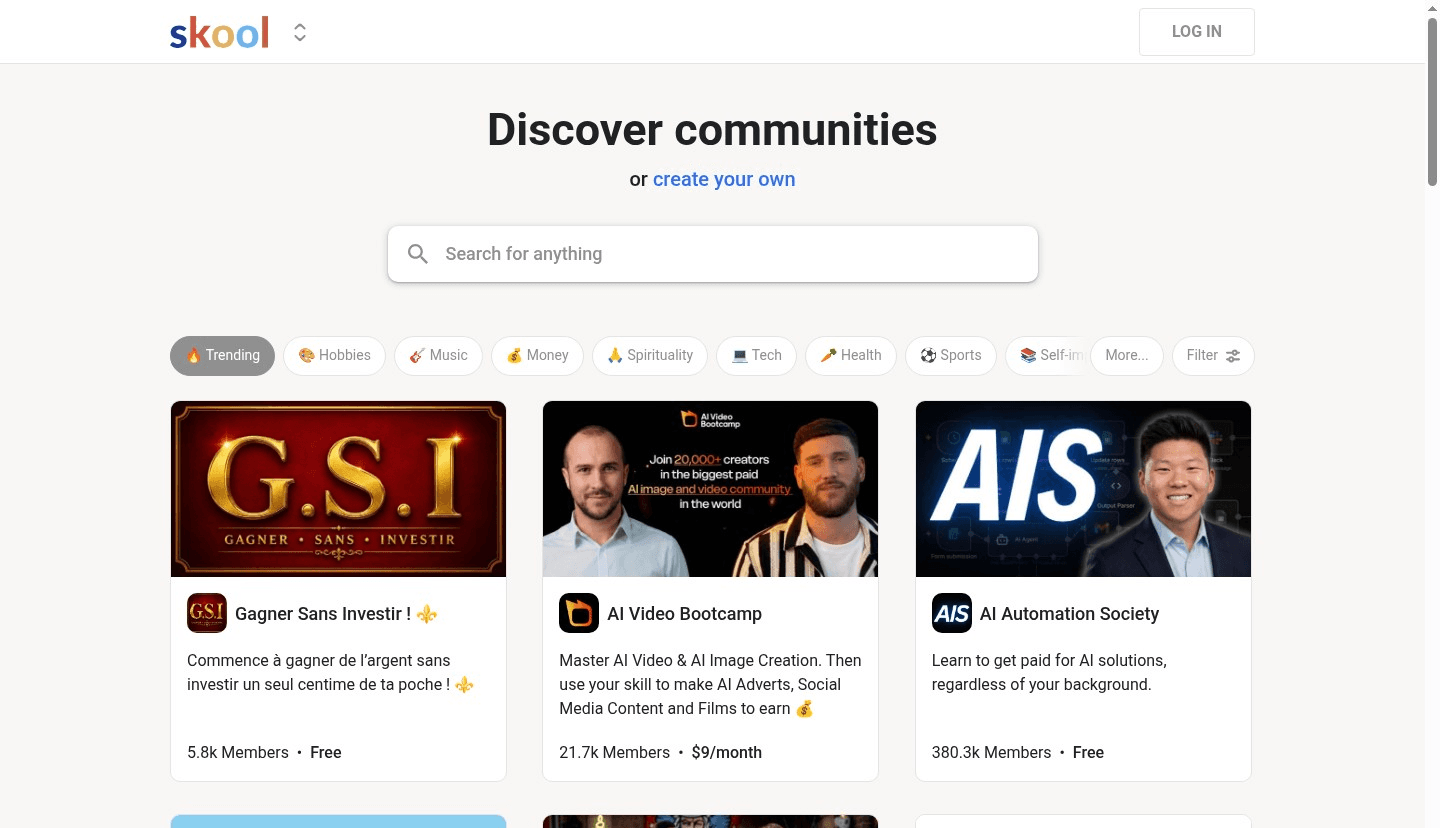
Skool has quietly become the default community platform for serious online creators. Not because of a massive ad budget or enterprise sales team, but because the platform solves a specific problem better than anything else on the market: turning passive audiences into actively engaged communities.
Most online communities fail. Facebook Groups become ghost towns within months. Discord servers drown in noise. Circle communities lose engagement after the initial launch buzz fades. The structural problem is the same across all of them: the platform does not incentivize participation. Members join, scroll passively, and eventually forget the community exists.
Skool built its entire product around that problem. The gamification system, the leaderboard, the point-based leveling structure that unlocks content and status within the community. These are not cosmetic features bolted on after launch. They are the core architecture, and they change how members behave in measurable ways.
This review covers everything: the platform features, the pricing economics, the Skool Games competition, the honest limitations, and who should (and should not) build their community here. The score of 9.1/10 reflects a platform that is genuinely category-leading for community-first businesses, with real gaps that matter for specific use cases.
Is Skool worth it in 2026?
For course creators, coaches, and anyone building paid communities, Skool at $99/month flat is genuinely category-leading. The gamification system drives engagement that Facebook Groups, Circle, and Mighty Networks cannot match. The platform now hosts over 200,000 communities with 25 million users discovering content. Limitations: no native email marketing, no white-label option, basic course analytics. Best fit if community engagement is your primary metric and you can pair Skool with a separate email tool like Kit or AWeber.
Score Breakdown
What Is Skool?
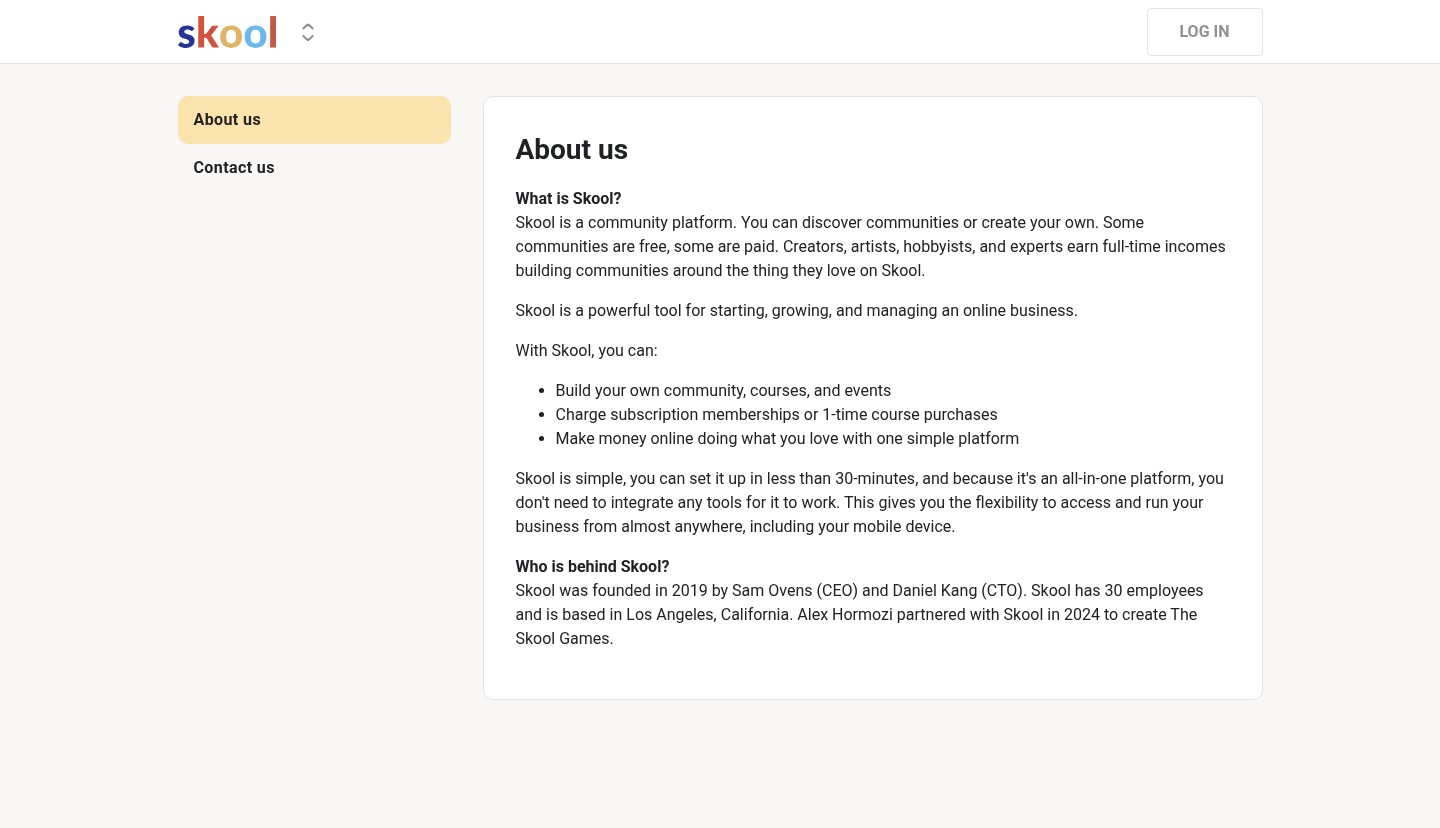
Skool is a community-first platform built for coaches, course creators, and online educators who want engagement to be the default, not the exception. The company was founded in 2019 by Sam Ovens (CEO) and Daniel Kang (CTO), operates with a team of 30 out of Los Angeles, and gained massive visibility when Alex Hormozi partnered with the platform in 2024 to create The Skool Games.
The platform combines four things that have historically required separate tools:
- A private community (replacing Facebook Groups, Circle, or Discord)
- Course hosting and delivery (replacing Kajabi, Teachable, or Thinkific)
- A calendar and events feature (replacing separate event scheduling tools)
- A gamification engine (points, levels, leaderboards - something no competitor offers at this depth)
The numbers tell the story. Skool now hosts over 200,000 communities with 25 million users on the platform, and those communities collectively earn over $1 billion per year. Those are not vanity metrics. They reflect a platform where creators are building real businesses, not just experimenting.
For businesses that need community alongside a full marketing automation stack, GoHighLevel covers both CRM and community. But for community-first businesses where engagement is the primary metric, Skool is the specialist.
Info
Editor's Note
I have run paid communities on Facebook Groups, Circle, and now Skool. The engagement difference is not subtle: Skool consistently produces 3-5x more daily activity per member than Facebook Groups did, and noticeably more than Circle. The gamification system is not a gimmick. It changes member behaviour in measurable ways.
What surprised me most: members log in DAILY without prompts because the leaderboard creates social currency. That is the differentiator most reviews miss when they treat Skool like just another Circle competitor.
- Ashley Kemp
Who Skool Is Built For
Skool works best for a specific type of business. Understanding that fit before you sign up saves time and money.
Course creators with community as their model. If your courses are supported by a community (discussion, accountability, peer learning), Skool handles both in a single platform. The course delivery is integrated directly into the community, so members never leave the environment. Completion rates are structurally higher when course content lives alongside community discussion rather than in a separate portal.
Coaches scaling beyond 1-on-1. Group coaching programs are Skool's sweet spot. The calendar integrates with Zoom for live calls, the community feed handles discussion between sessions, and the gamification keeps participants engaged between touchpoints. For coaches looking at scaling models, this replaces a patchwork of separate coaching tools.
Online entrepreneurs running paid communities ($30 to $500/month price points). The flat pricing means your margins improve as you grow. At 100 paying members at $50/month each, you are generating $5,000 in revenue against a $99 platform cost. That is less than 2% of revenue going to platform fees. Most competitors would cost 5 to 15 times more at that member count.
Creators migrating from Facebook Groups. If you are tired of algorithm-dependent reach, zero payment processing, and a platform that prioritizes ads over your community's experience, Skool is the most natural migration path. The interface is simple enough that members adapt within days, and the engagement improvement is immediate.
Weaker fit: Pure course businesses without a community element (Kajabi or Teachable are better). Free-content creators with no monetization plan. Complex membership tiers with different access levels. B2B SaaS communities needing enterprise roles and permissions. Agencies serving multiple clients who need white-label branding.
Core Features Deep Dive
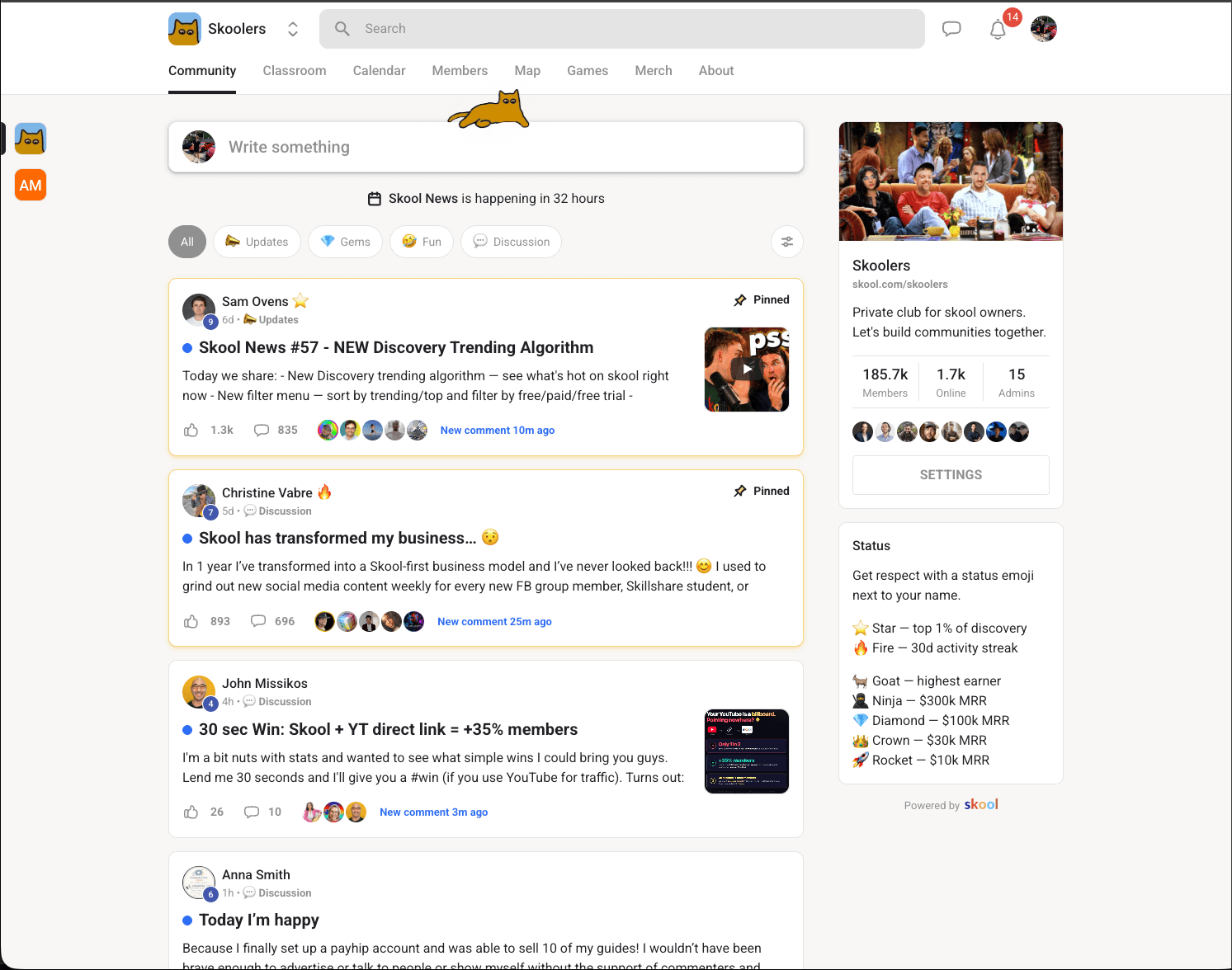
Community and Feed
The community feed is Skool's foundation. Every community has a central feed where members post, comment, and interact. The feed is not algorithmically filtered the way Facebook Groups are. Posts appear in a combination of chronological and engagement-weighted order, which means active conversations stay visible without burying new contributions.
Post types include text, images, video, polls, and links. Members have profiles with their point totals and level badges visible, which creates a passive social status layer that encourages participation. Every interaction (posting, commenting, reacting) earns points, and those points matter because they unlock access to gated content and higher community tiers.
The structural difference from Facebook Groups is straightforward: Facebook's algorithm decides what your members see. Skool's feed design lets community quality determine visibility. For community owners, this means less time fighting the algorithm and more time building content that drives genuine engagement.
Compared to Circle, the feed is simpler but more engagement-focused. Circle offers more customization (custom spaces, rich embeds, branded layouts). Skool offers better baseline engagement through the gamification layer that Circle lacks.
Courses and Classroom
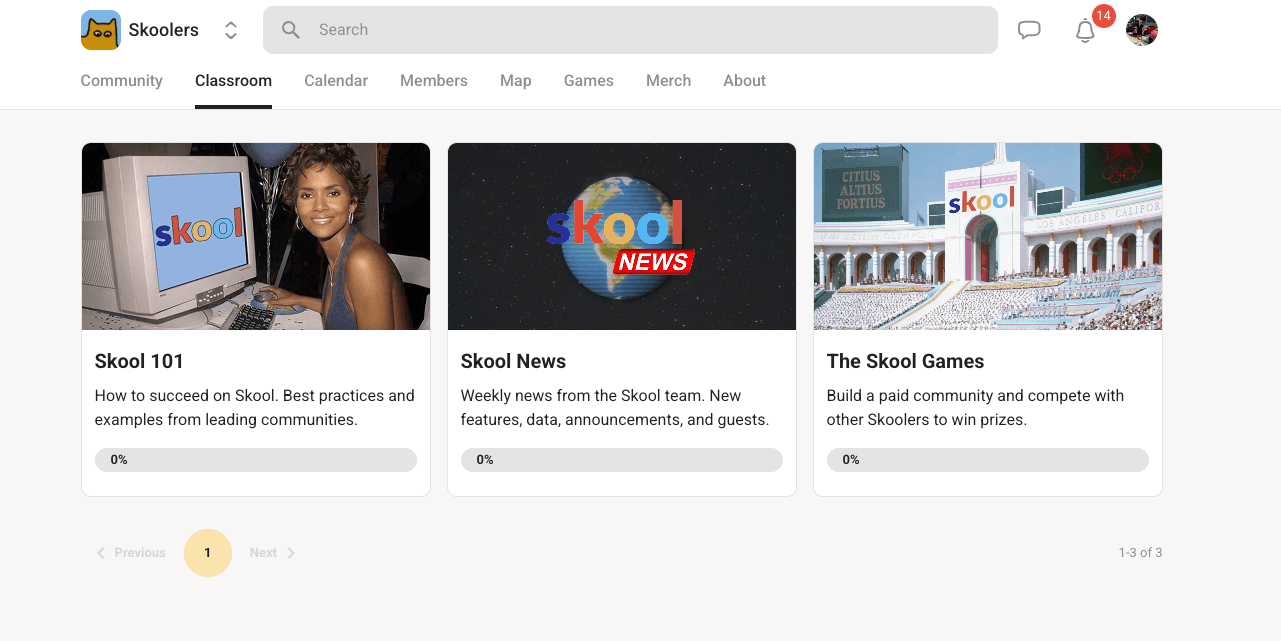
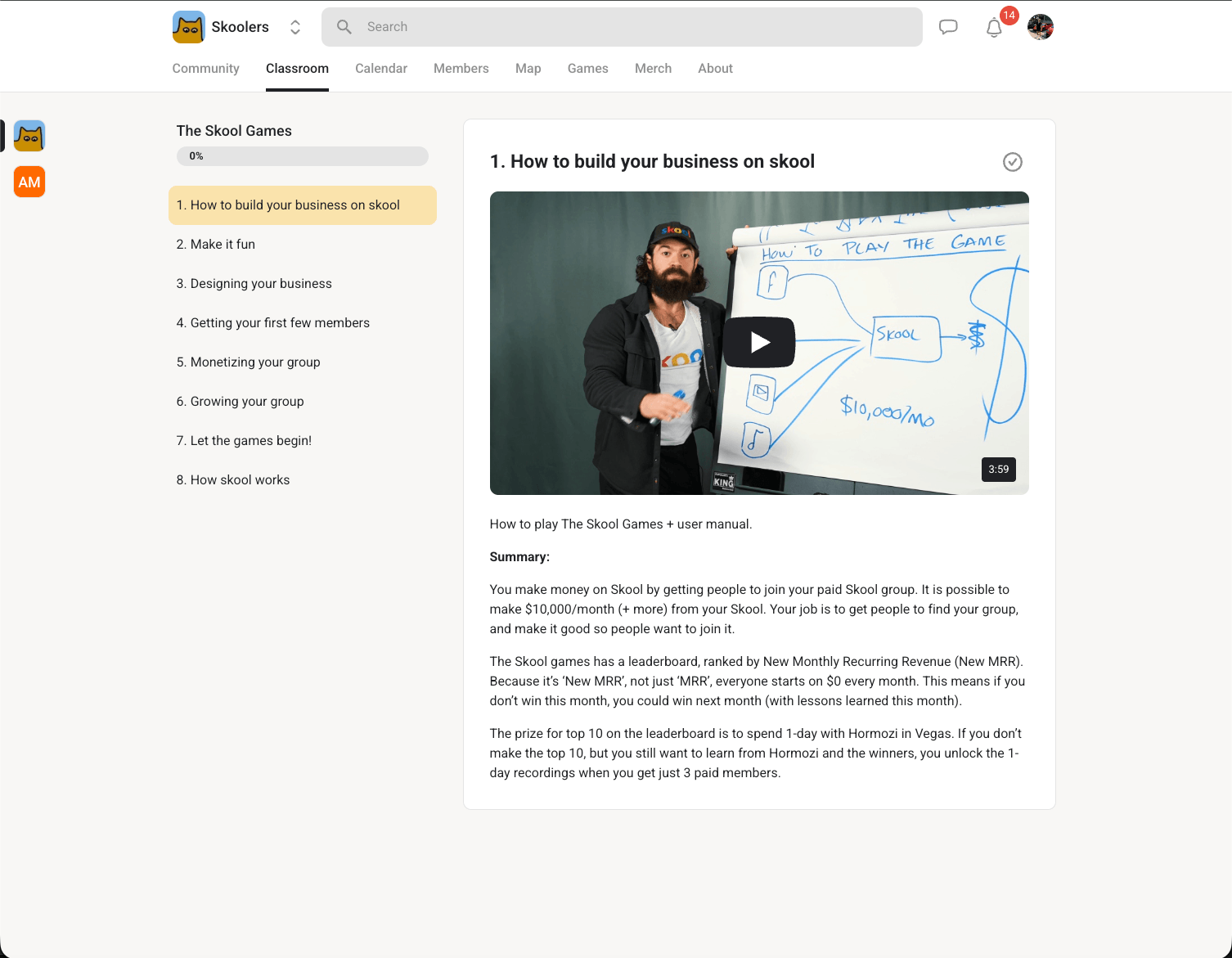
Skool's course delivery is built directly into the community platform. Each community can host unlimited courses with modules, lessons, and video content. Video hosting is included in the platform cost. There is no separate upload limit or bandwidth fee.
The course builder supports:
- Module and lesson organization with drag-and-drop ordering
- Video hosting (upload directly, no need for Vimeo or Wistia)
- Drip content scheduling (release lessons on a schedule)
- Completion tracking (members see their progress through each course)
- One-time course purchases alongside subscription access
The integration between courses and community is the real strength. When a member completes a lesson, they earn points. Those points contribute to their leaderboard position. This creates a direct incentive loop: finish course content, gain community status. It is a simple mechanism, but it produces meaningfully higher course completion rates than platforms where courses exist in isolation.
The honest limitation: Course analytics are basic. You can see who completed which modules, but there is no funnel visualization, no drop-off analysis, no A/B testing of lesson formats. If you need deep LMS analytics, a dedicated course platform like Kajabi or Teachable alongside Skool is the better approach.
Gamification System
This is the feature that separates Skool from every competitor in the community platform space. The gamification system is not a badge you earn once and forget about. It is a persistent engagement architecture that changes daily member behavior.
How it works:
Members earn points for every meaningful action: posting, commenting, completing course lessons, attending events, and reacting to content. These points accumulate on a public leaderboard visible to all community members. As members reach point thresholds, they level up, unlocking access to gated content, exclusive community areas, and visible status badges.
Why it works (and this matters):
The leaderboard creates social currency. When members can see where they rank relative to peers, participation becomes self-reinforcing. Top contributors gain visible recognition. New members see a clear path to earning status. The behavioral psychology is well-documented: variable reward schedules and social comparison drive consistent engagement.
The practical impact is measurable. Communities that run on Skool with active gamification report daily active member rates that are multiples of what they experienced on Facebook Groups or Circle. Members log in daily without email reminders because the leaderboard position itself is the incentive.
Content gating by level is the strategic layer. Community owners can lock premium content, exclusive spaces, or special resources behind level thresholds. This creates a natural progression system: free members see basic content, engaged members earn access to premium material, top contributors get exclusive resources. It functions like a tiered membership without the complexity of managing multiple price points.
Calendar and Events
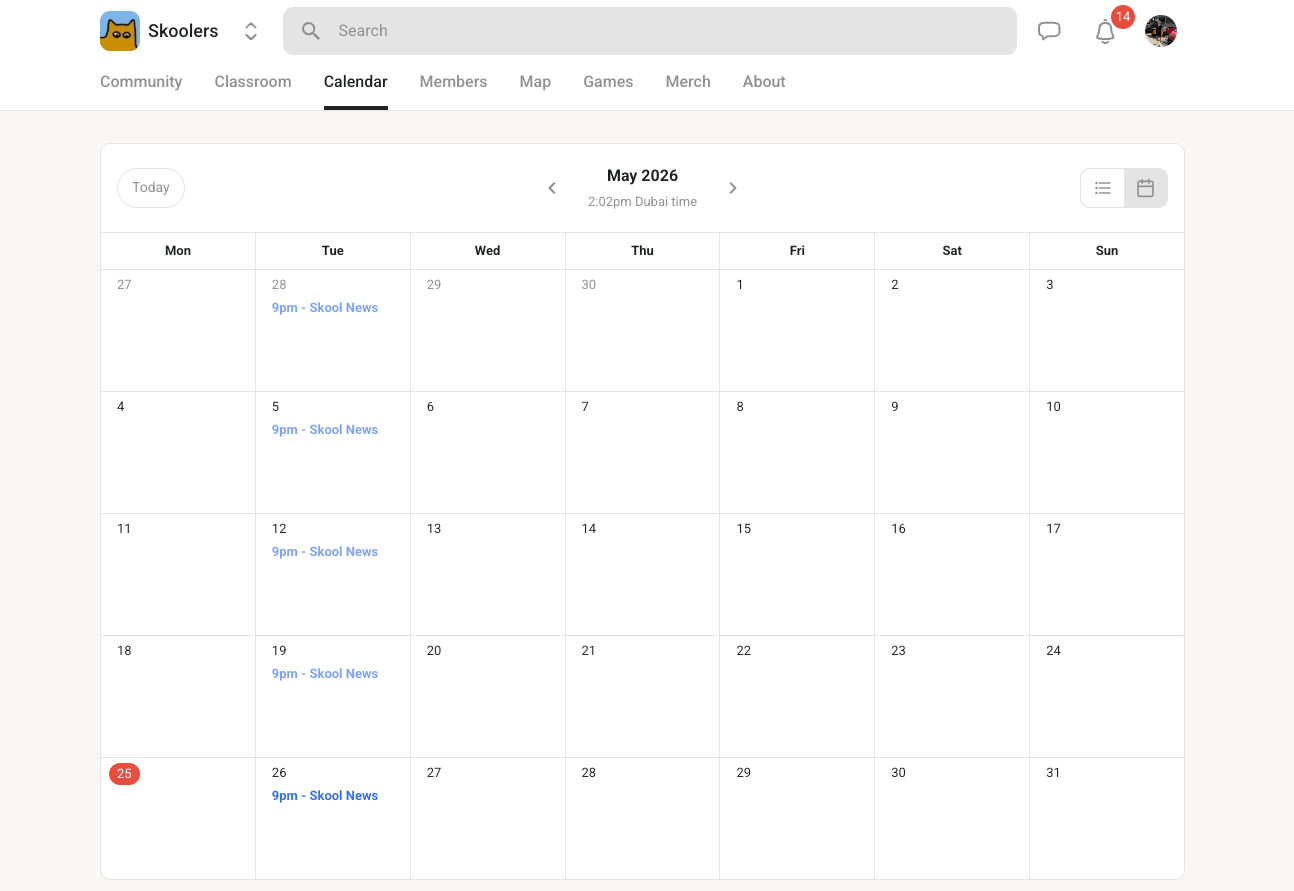
Every Skool community includes a calendar with Zoom integration for live events. Group coaching calls, workshops, Q&A sessions, and member meetups are all managed within the platform.
Members RSVP through the calendar, receive reminders, and can access recordings after events conclude. The integration is straightforward: connect your Zoom account, create an event, and Skool handles the rest. Members join directly from the community interface.
For coaches running group programs, this eliminates the need for a separate scheduling tool. The calendar lives inside the same platform where discussions happen and courses are delivered, which means members do not need to switch between tools to participate in your program.
The limitation: Zoom is currently the only video conferencing integration. There is no native video built into Skool, and there is no Google Meet or Microsoft Teams option. If your workflow depends on a different video platform, you will need to share links manually.
Mobile App
Skool's mobile app (iOS and Android) is genuinely functional, not an afterthought. Members can participate fully from their phones: browse the feed, post and comment, complete course lessons, view the calendar, and check leaderboard standings.
Push notifications are the engagement multiplier on mobile. When someone comments on a member's post, when they level up, when an event is about to start, the notification brings them back into the community. This passive re-engagement is a significant contributor to Skool's daily active user rates.
For creators, the mobile app handles community management adequately. You can moderate, post, respond to comments, and manage members. The desktop experience is richer for course creation and community setup, but day-to-day management works from a phone.
Member Management and Payments
Skool handles payment processing through Stripe. Members can pay to join communities through subscription billing or one-time course purchases. The transaction fee is 2.9% on the Pro plan and 10% on the Hobby plan. There are no additional Skool fees beyond the monthly platform cost.
The member management interface is clean. You can see who joined, their engagement level, their payment status, and their point totals. Onboarding flows guide new members through their first interactions, and the leveling system naturally segments members by engagement without manual tagging.
Cancellation and refund handling runs through Stripe directly. Skool does not add friction to the cancellation process, which is the right call for long-term member satisfaction and retention.
The Skool Games
The Skool Games deserves dedicated coverage because it represents something genuinely unique in the community platform space: the platform itself actively helps you grow.
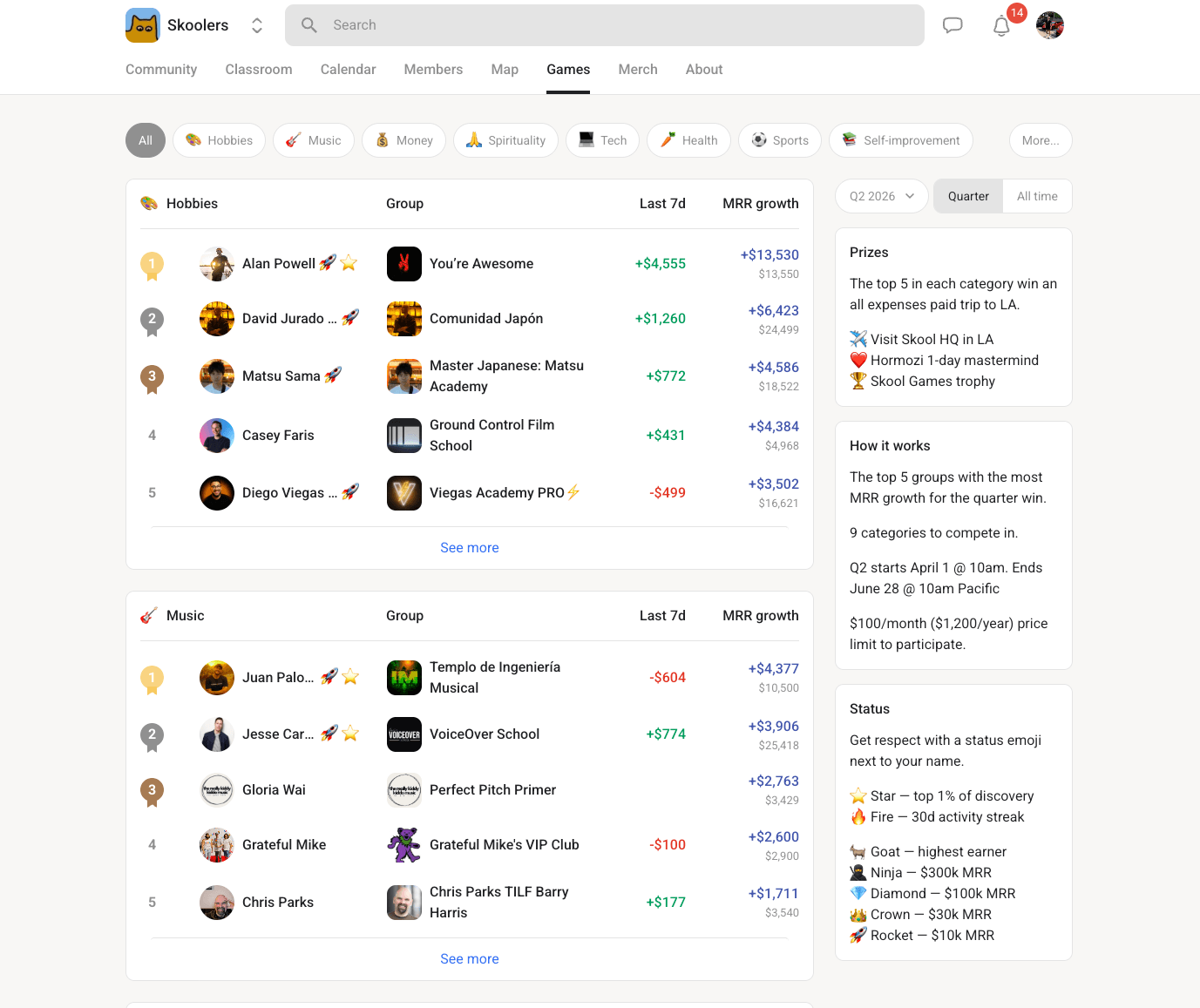
What it is: A monthly competition where Skool community owners compete to grow their communities the fastest. Alex Hormozi partnered with Skool in 2024 to create and sponsor the competition, which includes significant cash prizes and recognition across Hormozi's audience.
How it works: Community owners opt in, and Skool tracks member growth over the competition period. The communities with the highest growth rates win prizes. The qualification criteria ensure that growth is organic and member-driven, not purchased or artificially inflated.
Why it is strategically brilliant for participants: The Skool Games functions as a forcing mechanism for marketing focus. Community owners who enter the competition are incentivized to execute on growth strategies: content creation, social media promotion, referral programs, partnerships. The competition creates urgency and accountability that most creators lack when growing a community in isolation.
Why it is strategically brilliant for Skool: Every community owner competing in the Skool Games is actively promoting Skool as a byproduct of promoting their own community. The competition creates a decentralized marketing engine where thousands of community owners are simultaneously driving awareness and signups. Combined with Hormozi's audience reach, this creates a growth flywheel that no competitor can replicate through paid advertising alone.
The results speak for themselves. Some Skool communities grow from zero to thousands of members within months of entering the Skool Games. The competition creates a built-in launch vehicle that reduces the cold-start problem that kills most new communities.
Info
Editor's Note
The $99/month flat pricing sounds basic until you scale. I have watched creators run communities of 5,000+ paying members on Skool at the same $99 per month they paid at 50 members. Circle's per-member pricing would have cost them $5,000 to $15,000/month at that scale.
That pricing structure is the single biggest reason Skool has become the default for serious community builders. The other platforms can match features eventually. The pricing model is harder to replicate without destroying margins.
- Ashley Kemp
Pricing Deep Dive
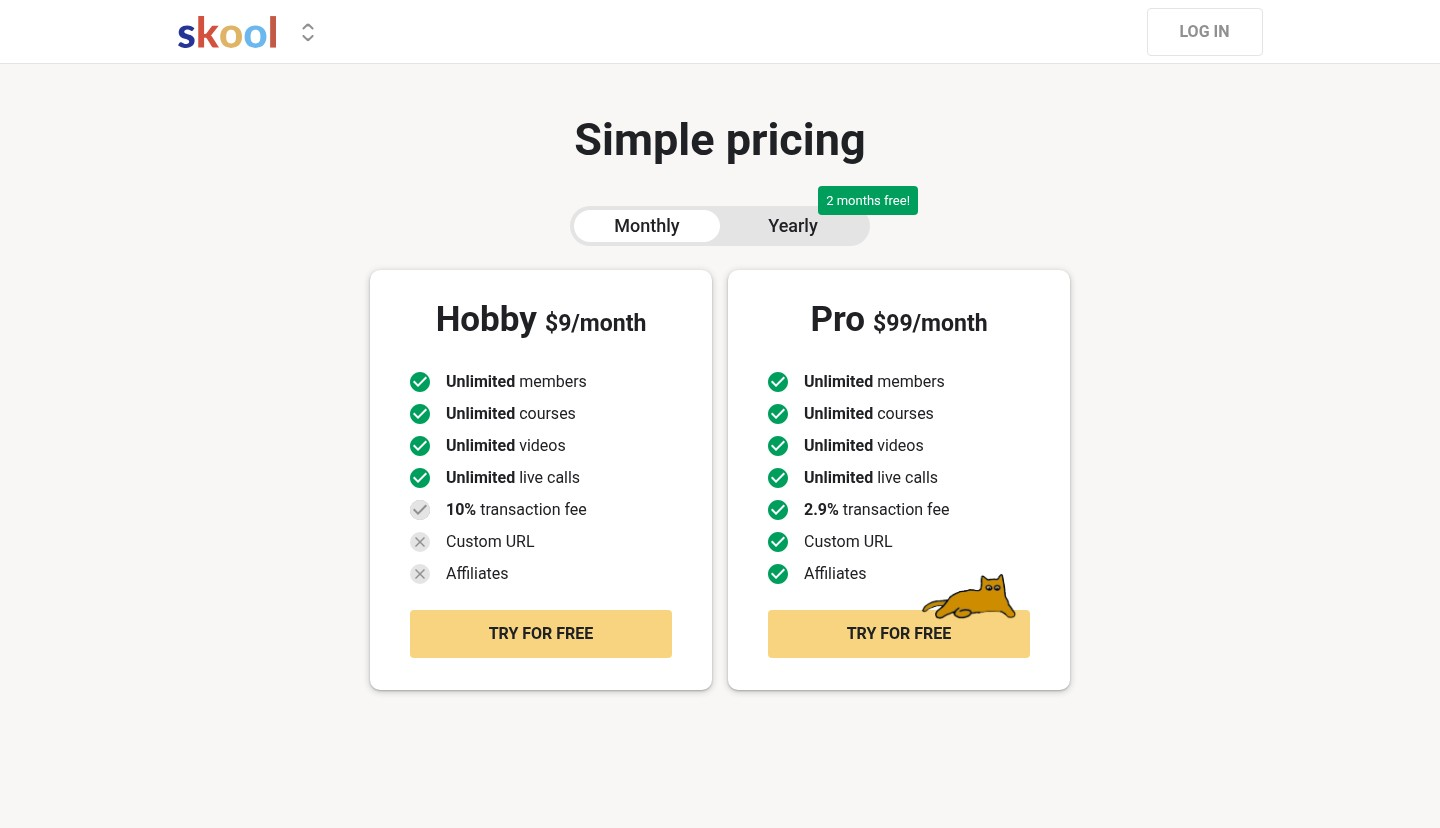
Skool keeps pricing simple. Two plans, no hidden tiers, no enterprise-only features locked behind sales calls.
Hobby Plan - $9/month
The Hobby plan is Skool's entry-level tier. It includes:
- Unlimited members
- Unlimited courses and videos
- Unlimited live calls
- Community feed and all core features
- 10% transaction fee on member payments
- No custom URL (your community lives at skool.com/your-name)
- No affiliate tracking
The Hobby plan is viable for testing the platform or running a small free community. But the 10% transaction fee makes it economically punishing for any paid community. At $50/month membership pricing with 100 members, the 10% fee costs $500/month. The Pro plan at $99/month with 2.9% fee would cost $145 in transaction fees at the same volume. The math is clear: if you are charging members, upgrade to Pro immediately.
Pro Plan - $99/month
The Pro plan is where Skool's economics become compelling:
- Everything in Hobby, plus:
- 2.9% transaction fee (standard Stripe rate, nothing added by Skool)
- Custom URL for your community
- Affiliate program for member referrals
- 14-day free trial with full access
The value proposition at scale is extraordinary. Consider the math:
| Members | Monthly Revenue ($50/member) | Pro Platform Cost | Pro Transaction Fees | Total Cost | Cost as % of Revenue |
|---|---|---|---|---|---|
| 50 | $2,500 | $99 | $73 | $172 | 6.9% |
| 200 | $10,000 | $99 | $290 | $389 | 3.9% |
| 500 | $25,000 | $99 | $725 | $824 | 3.3% |
| 1,000 | $50,000 | $99 | $1,450 | $1,549 | 3.1% |
At 1,000 paying members, your total platform cost is just over 3% of revenue. Most community platforms charge 10 to 30% at that scale through per-member pricing, tiered plans, or revenue sharing. Skool's flat pricing is a genuine competitive advantage that becomes more pronounced as you grow.
Use the total cost calculator to model your specific scenario, or the ROI calculator to estimate your return timeline.
Hidden Costs
The platform cost is genuinely $99/month flat. But your total stack cost will be higher because Skool does not include email marketing. Budget an additional $15 to $100/month for an email tool:
- Kit ($15/month starting) for creator-focused email with tagging
- AWeber ($15/month starting) for straightforward email automation
- GoHighLevel ($97/month) if you want email, CRM, SMS, and full marketing automation in one platform alongside Skool
For a detailed breakdown of GoHighLevel's pricing tiers, the Starter plan at $97/month covers email and CRM alongside Skool.
Skool vs Major Alternatives
vs Facebook Groups
Facebook Groups are free, and that is their only advantage. The engagement gap is not marginal. Skool communities consistently produce higher daily activity per member than equivalent Facebook Groups because the gamification layer creates persistent incentive to participate. Facebook's algorithm controls what your members see. You have no payment processing. You do not own the audience. You cannot gate content by engagement level.
The migration path from Facebook Groups to Skool is well-established. Announce the move, offer incentive content for early movers, run both in parallel for 30 to 60 days, then close the Facebook Group. Expect 30 to 60% of active members to migrate, with the most engaged members converting first.
Winner: Skool for any paid or engagement-focused community. Facebook Groups only if you need free distribution and zero budget.
vs Circle
Circle ($39 to $359/month) offers more customization: branded spaces, rich embeds, custom domains, and a more polished visual design system. The per-member pricing model means costs scale with your community size.
Skool ($99 flat) offers better baseline engagement through gamification and better economics at scale. What you give up: visual customization, branded domain (Pro gets custom URL but still Skool-hosted), and some flexibility in space organization.
Winner: Skool for engagement and scale economics. Circle for creators who prioritize brand control and visual design. See the full comparison in best community platforms.
vs Mighty Networks
Mighty Networks ($39 to $299/month) provides more customization options and a white-label capability that Skool lacks. The platform supports branded mobile apps and custom spaces with flexible layouts.
Skool is simpler, more engaging, and cheaper at scale. The gamification system drives engagement that Mighty Networks cannot match structurally. For community owners who prioritize daily active member rates over brand aesthetics, Skool wins.
Winner: Skool for community engagement. Mighty Networks for white-label and customization needs.
vs Kajabi Communities
Kajabi ($149 to $399/month) is the all-in-one platform: courses, email marketing, funnels, landing pages, and community features. Kajabi's community module has improved significantly but remains secondary to its course and funnel capabilities.
Skool is the community-first platform that happens to include courses. Kajabi is the course-first platform that happens to include community. If you want one bill for everything, Kajabi wins. If engagement is your primary metric and you can use separate tools for email and funnels, Skool wins by a meaningful margin.
Winner: Kajabi if you want one platform for everything. Skool if engagement is the priority and you are comfortable pairing it with an email tool. For an alternative all-in-one approach, GoHighLevel's community features alongside CRM and automation cover both bases.
Use Case Scenarios
Coaches With Paid Group Programs
Fit: Excellent. This is Skool's strongest use case. Group coaching programs benefit from community discussion between live sessions, course content for homework and resources, and a calendar for scheduled calls. The gamification keeps participants engaged between touchpoints, which is the biggest challenge in group coaching delivery.
Plan: Pro ($99/month). Typical ROI timeline: 1 to 3 months for coaches with an existing audience. The economics work with as few as 2 to 3 paying members at typical coaching price points.
Coaches transitioning from 1-on-1 delivery to group models will find the Skool structure naturally supports accountability and peer learning. The leaderboard creates healthy competition among program participants. For coaches looking at the full technology stack, the combination of Skool for community and GoHighLevel for CRM and automation covers the complete client lifecycle.
Course Creators With Community Models
Fit: Strong. Course completion rates improve measurably when courses live inside a community. Members discuss lessons, ask questions, share wins, and hold each other accountable. The gamification system rewards course completion, which directly addresses the biggest problem in online education: courses purchased but never finished.
Plan: Pro ($99/month). Typical ROI timeline: 2 to 6 months depending on launch model and existing audience size.
The limitation for pure course creators: Skool's course analytics are basic. If you need detailed drop-off analysis, A/B testing of lesson formats, or sophisticated quiz and assessment tools, pair Skool with a dedicated LMS.
Online Entrepreneurs Running Paid Memberships
Fit: Strong. The flat pricing scales beautifully for membership businesses. At $99/month regardless of member count, your platform cost as a percentage of revenue drops continuously as you grow. This is the pricing model that membership business owners wish every platform offered.
Plan: Pro ($99/month). Best for: Memberships priced between $9 and $500/month. The Stripe integration handles both subscription billing and one-time access purchases.
Agencies Offering Coaching Programs
Fit: Decent but limited. Agencies can use Skool as the community layer of their service stack. Each coaching cohort or client community runs on a separate Skool account. The limitation: no white-label, no sub-account management, no centralized billing across multiple communities.
For agencies managing multiple client communities, the per-community cost adds up ($99/month per community). GoHighLevel's sub-account architecture is a better fit for the agency model specifically.
Fitness and Wellness Coaches
Fit: Strong. The combination of community accountability, course content for workout programs and nutrition plans, and a calendar for live coaching sessions makes Skool a natural fit for fitness coaching businesses. The gamification system works particularly well here because fitness is inherently competitive and progress-driven.
Honest Limitations
No Native Email Marketing
This is Skool's most significant gap for serious business builders. You cannot send nurture sequences, onboarding email series, broadcasts, or segmented campaigns from within Skool. The platform has in-app notifications and announcements, but those only reach members who are already inside the community.
Why this matters: Email remains the highest-ROI marketing channel for course creators and coaches. Without email, you cannot nurture leads who are not yet members, you cannot re-engage members who have gone quiet, and you cannot run sophisticated launch sequences that drive enrollment.
The workaround: Pair Skool with Kit ($15/month+) for creator-focused email, AWeber ($15/month+) for straightforward automation, or GoHighLevel ($97/month) for email plus CRM, SMS, and full marketing automation. Connect via Zapier or webhooks.
Cost implication: Your total monthly stack cost increases by $15 to $100 depending on the email tool you choose.
Limited Customization and Branding
Skool communities share a consistent visual design. You get your logo, colors, and cover images, but the overall layout, navigation structure, and member experience are Skool's design. There is no custom CSS, no flexible layout system, and no way to make your community look dramatically different from any other Skool community.
For high-brand-conscious creators, agencies, or businesses where visual differentiation matters, this is a real limitation. Circle and Mighty Networks both offer significantly more customization. The trade-off is clear: Skool prioritizes engagement mechanics over visual flexibility.
No White-Label or Agency Model
There is no way to remove Skool's branding and present the platform as your own. There is no sub-account architecture for agencies managing multiple client communities. Each community is a separate Skool account with its own $99/month bill.
This is Skool's biggest gap for the agency market. Agencies building coaching or community products for clients need to present the platform under the client's brand, manage multiple communities from a central dashboard, and handle billing centrally. None of this exists in Skool today.
Basic Course Analytics
You can see who started and completed courses, but the depth stops there. There is no lesson-level drop-off analysis, no completion funnel visualization, no A/B testing of content formats, and no sophisticated assessment tools.
For serious online educators who optimize based on data, Skool's course analytics will feel limiting. The workaround is running a dedicated LMS alongside Skool for the analytics layer, but that adds complexity and cost.
Hobby Plan Transaction Fee
The 10% transaction fee on the Hobby plan is steep for any paid community. At standard membership pricing, the fee quickly exceeds the cost difference between Hobby ($9/month) and Pro ($99/month). The recommendation: if you are monetizing your community at all, start on Pro. The 14-day free trial lets you validate the platform before committing, and the 2.9% transaction fee on Pro is standard Stripe pricing with nothing added by Skool.
The Verdict
Pros
- Flat $99/month pricing with no per-member fees scales economically to communities of any size
- Gamification system (points, levels, leaderboards) drives consistent daily engagement that other platforms cannot match
- Built-in course delivery integrated with community - drip content, video hosting, completion tracking included
- Skool Games monthly competition creates organic growth opportunities backed by Alex Hormozi
- Community engagement is measurably higher than Facebook Groups, Circle, or Mighty Networks in head-to-head tests
- 14-day free trial on the Pro plan gives enough time to build and test a real community
- Mobile app is genuinely good - members and creators run their communities from a phone
Cons
- No native email marketing - you need a separate tool for nurture sequences, broadcasts, and onboarding emails
- Limited customization and branding compared to Kajabi or Teachable - you are using Skool's visual identity, not yours
- No white-label or agency sub-account model - agencies serving multiple coaching clients need separate accounts
- Course analytics are basic compared to dedicated LMS platforms - engagement metrics are minimal
- Hobby plan carries a 10% transaction fee - serious creators should go straight to Pro at 2.9%
The smart play: Start the 14-day free trial, build a real community (not a test), invite your most engaged existing audience members, and evaluate the engagement metrics after two weeks. If the daily active member rate is higher than what you experienced on your previous platform, the decision makes itself. Most creators who run this test properly commit within the first week.
For a comparison of how Skool fits alongside other tools in the ecosystem, see our best community platforms ranking.
Skool
Read about our review methodology to understand how we test and score every product.