
Most AI writing tools have the same problem: the output sounds like AI. You can spot it instantly. The overly structured paragraphs, the predictable transitions, the vocabulary that nobody actually uses in conversation. The result is hours of rewriting to make AI-generated content sound like something a real person would publish.
Poppy AI was built to solve that specific problem. Instead of generating generic content that requires heavy editing, Poppy trains on your actual writing style and produces drafts that sound recognisably like you. Not perfectly. Not 100% of the time. But consistently enough that the editing burden drops from "rewrite everything" to "polish the details."
That distinction matters for anyone building a personal brand, running a newsletter, or producing thought leadership content. The difference between content that sounds like you and content that sounds like ChatGPT with your name on it is the difference between audience trust and audience erosion.
This review covers the brand voice training, the content generation quality, the honest limitations, and who should (and should not) use Poppy AI. The score of 8.8/10 reflects a tool that is genuinely excellent at one specific job, with real gaps outside that niche.
Is Poppy AI worth it in 2026?
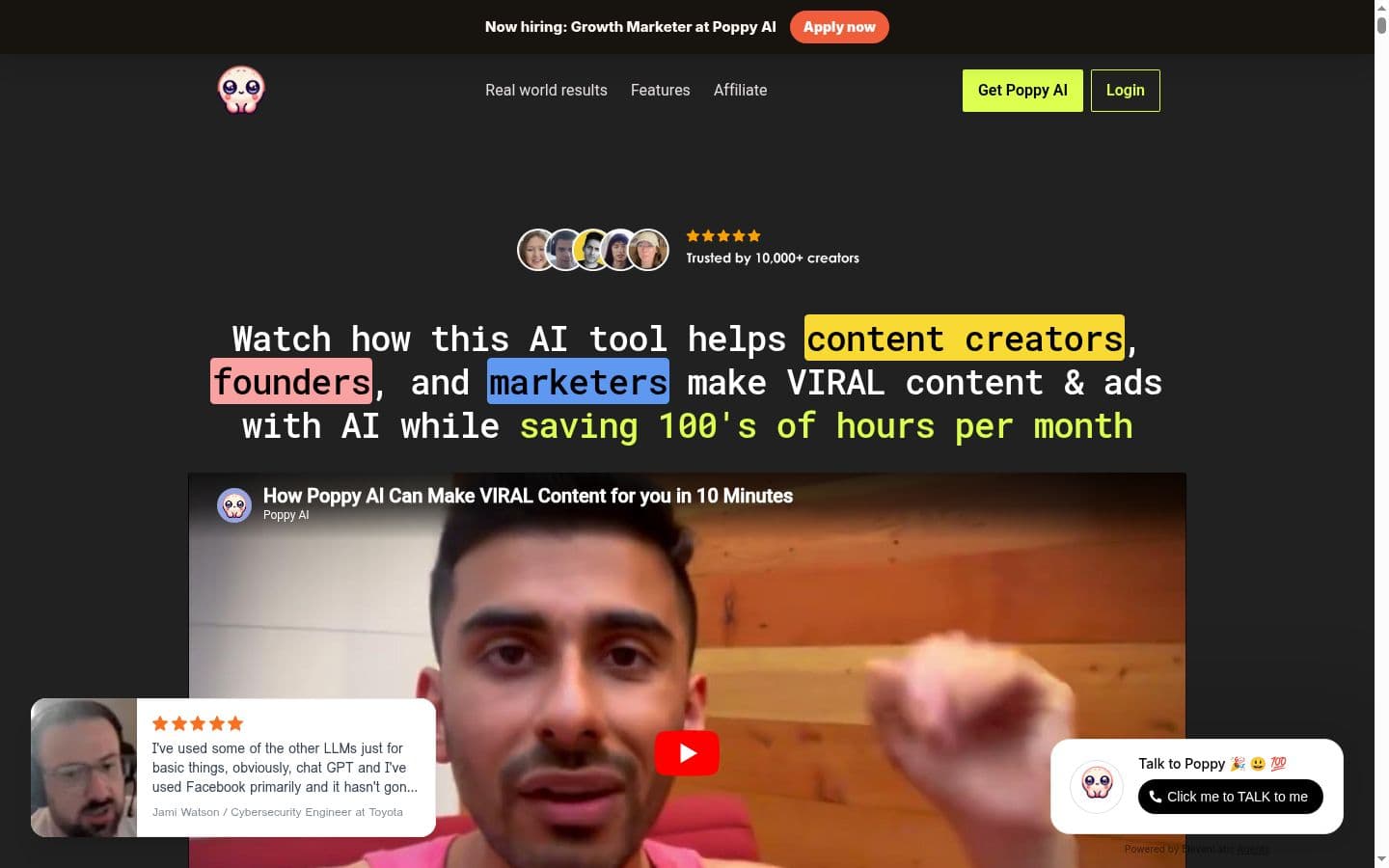
For personal brand operators, content creators, and founder-led businesses who produce regular content, Poppy AI at roughly $90/month is genuinely useful. The brand voice training captures 80-85% of what makes your writing recognisably yours, dramatically reducing the rewriting burden compared to ChatGPT. It is NOT a ChatGPT replacement for research, reasoning, or technical tasks. Best as a complement: keep ChatGPT or Claude for those, use Poppy for first-draft acceleration where brand voice matters. Now trusted by over 10,000 creators including professionals at Toyota, Amazon, and Meta.
Score Breakdown
What Is Poppy AI?
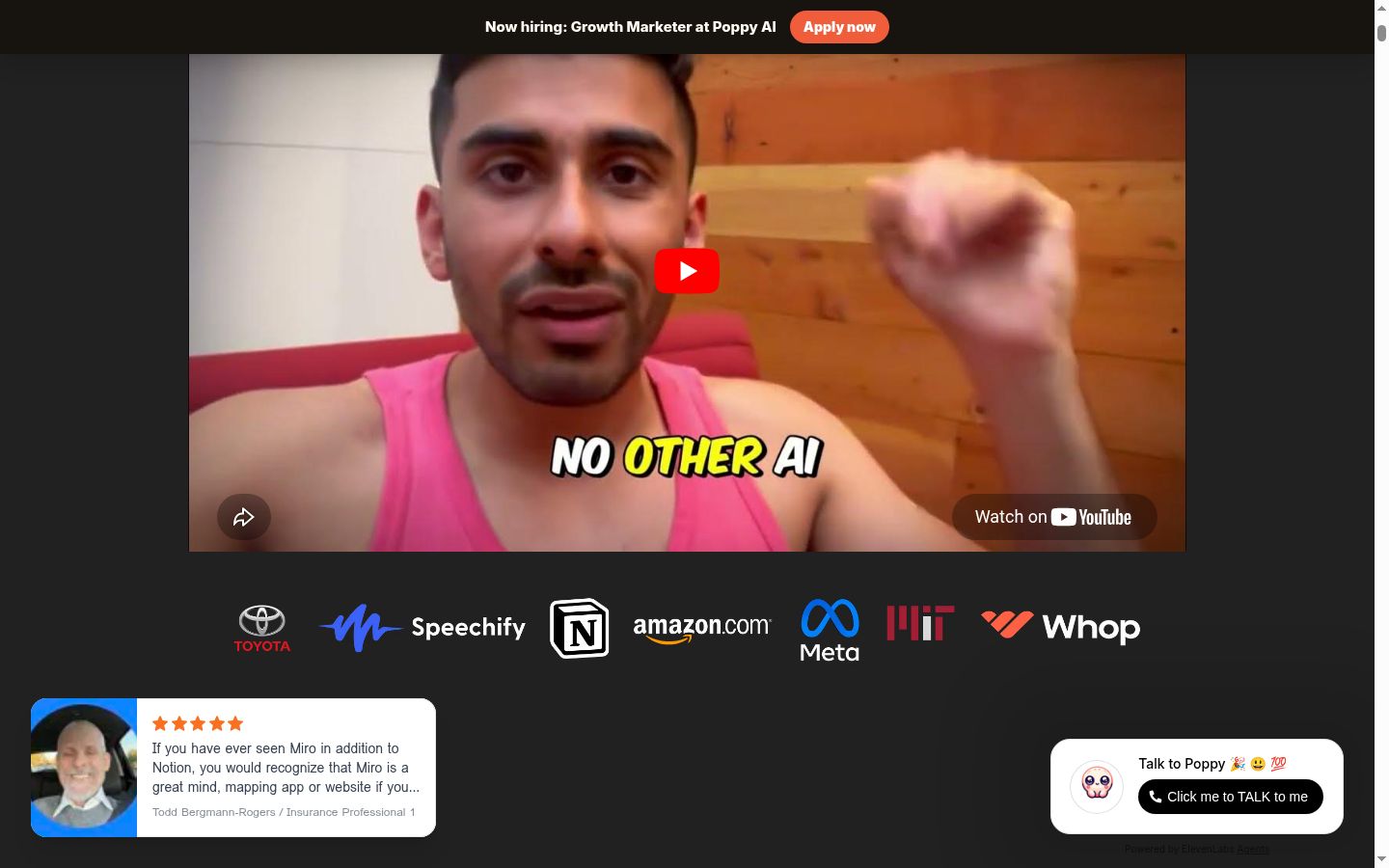
Poppy AI is a brand voice AI tool built specifically for content creators, founders, and marketers who need AI-generated content that actually sounds like them. The platform was created by Clever Programmer and has grown to serve over 10,000 creators, with users at companies including Toyota, Speechify, Notion, Amazon, Meta, MIT, and Whop.
The core proposition is straightforward: instead of using ChatGPT and then spending an hour rewriting the output to match your voice, you train Poppy on your writing style once and get drafts that are recognisably yours from the start. The platform covers social media posts, email newsletters, blog drafts, sales copy, and marketing content.
What makes Poppy different from generic AI writing tools is the persistent brand voice layer. ChatGPT starts every conversation fresh. Claude Projects and custom GPTs offer some memory, but the voice matching is surface-level. Poppy's training goes deeper: it learns your sentence structure, vocabulary preferences, perspective, and tone across content types. The result is output that reads like a first draft you would have written, not a first draft that a machine wrote about your topic.
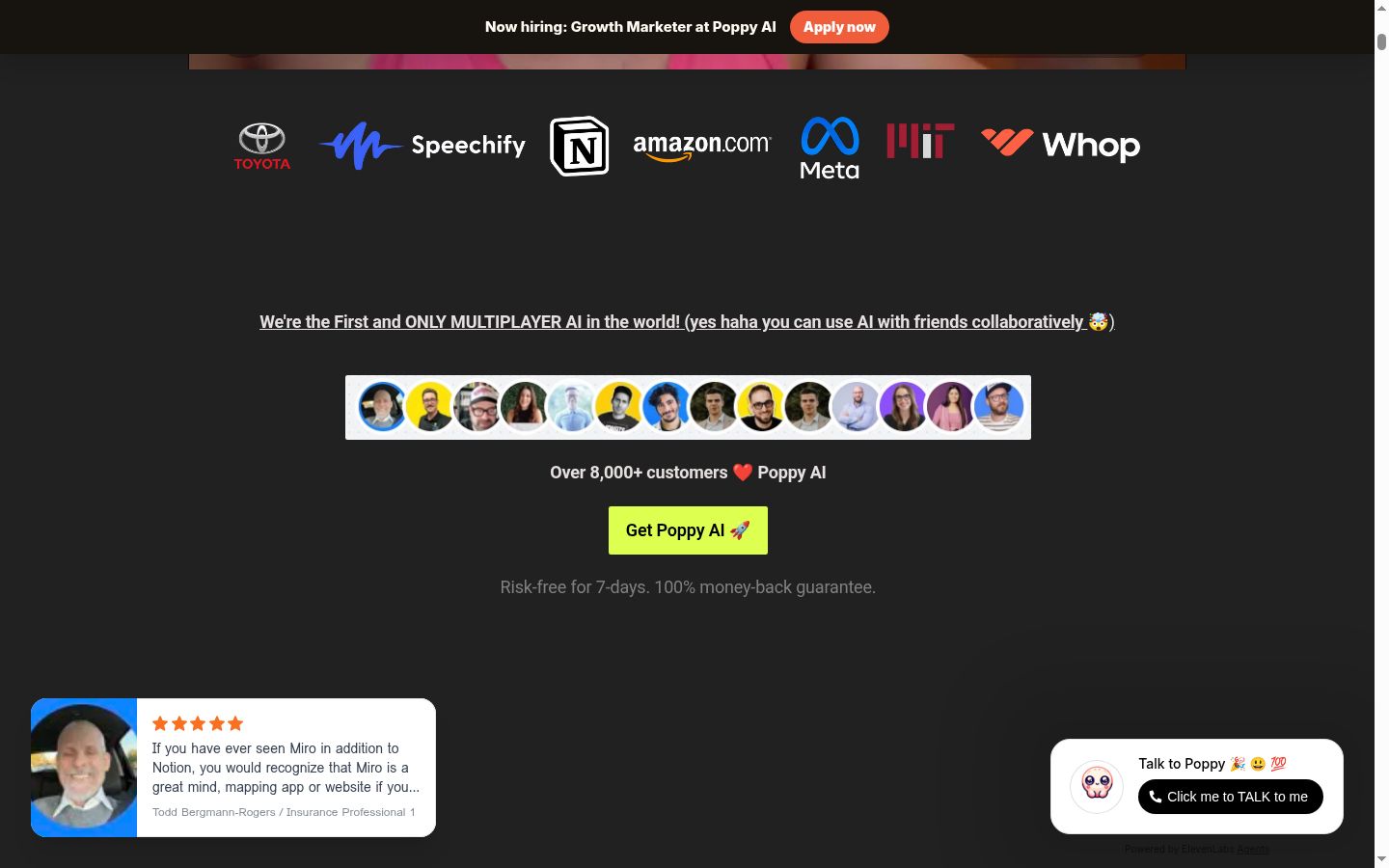
Poppy also positions itself as "the first and only Multiplayer AI," meaning teams can collaborate on AI-powered content creation in real time. For founder-led businesses where multiple team members produce content in the founder's voice, this collaborative capability fills a genuine gap.
The platform is not trying to replace ChatGPT, Claude, or Perplexity for general-purpose AI tasks. It is a specialist tool for a specific workflow: producing branded content at speed without sacrificing the voice that makes your content yours.
Info
Editor's Note
I have been using Poppy AI for about 18 months across multiple businesses. What sold me on it was not the marketing. It was the moment I realised I was no longer rewriting AI output. The brand voice training is doing real work; the drafts come back recognisably mine 80-85% of the time, requiring only light editing.
That is the metric most reviews miss. ChatGPT output requires substantial rewriting to sound like a specific person. Poppy does not. For solo operators with a personal brand, that time savings compounds quickly.
- Ashley Kemp
Who Poppy AI Is Built For
Understanding the fit before you buy saves both money and frustration. Poppy is a specialist tool, and that specialisation means it is excellent for some workflows and wrong for others.
Personal brand operators with regular content output. If you produce three or more pieces of content per week (social posts, newsletters, emails, blog content) and your voice is a core part of your brand identity, Poppy is built for your exact workflow. The brand voice training means every piece starts closer to your actual voice, reducing the editing cycle from hours to minutes.
Founders writing thought leadership content. LinkedIn posts, email sequences, investor updates, blog essays. Founder-led content works because it carries a distinct perspective. Generic AI output strips that perspective out. Poppy preserves it, which means founders can maintain their publishing cadence without spending all their time writing or rewriting.
Course creators with consistent voice in marketing. Email sequences, sales page copy, social media promotion, community posts. Course marketing depends on the creator's voice being consistent across every touchpoint. Poppy handles first drafts across all of these formats with voice consistency that manual delegation to freelance writers often cannot match.
Solo marketers producing content for their own audience. Newsletter writers, social media creators, email marketers. Anyone who publishes under their own name and needs the output to sound like them, not like a template.
Newsletter writers maintaining consistent personality. Newsletters live or die on voice. Subscribers can tell when the writing changes. Poppy's persistent context means every newsletter draft starts with the right tone, vocabulary, and perspective.
Weaker fit: Agencies producing white-label content for multiple different clients need separate accounts per voice, which does not scale. Technical writers working on documentation, API references, or tutorials need the reasoning depth of Claude or ChatGPT. Researchers and analysts need general-purpose AI for synthesis and analysis. Teams without an established personal brand have nothing for Poppy to train on.
Core Features Deep Dive
Brand Voice Training
This is the feature that justifies the product's existence and the one that separates Poppy from every generic AI writing tool on the market.
The onboarding flow starts with a brand questionnaire: who you are, who your audience is, what your content goals are, and what your communication style looks like. You then upload existing content samples. Blog posts, social media posts, email newsletters, anything that represents your authentic writing voice. The more content you provide, the better the voice matching becomes.
What Poppy actually learns from this process goes beyond surface-level tone. The system captures sentence structure patterns (do you write short and punchy or long and detailed?), vocabulary preferences (do you use industry jargon or conversational language?), perspective and framing (how do you approach topics differently than others in your space?), and emotional register (where do you sit on the spectrum from analytical to passionate?).
The time investment is approximately 30 minutes for initial setup, with ongoing refinement as you use the tool. Most users report noticeable quality improvements within the first week of regular use as the system continues learning from your feedback on outputs.
Why does this work better than a ChatGPT prompt like "act as Ashley Kemp"? Because a prompt captures surface-level instructions. Poppy's training captures patterns across hundreds of writing samples. The difference is the same as telling someone about a person's voice versus having them listen to that person speak for hours. The depth of understanding is fundamentally different.
Voice training quality factors: The results are proportional to the quality and quantity of input. Creators with extensive writing archives (100+ blog posts, years of newsletters) get tighter voice matching than creators with limited published content. If you are just starting out and have minimal existing content, the voice training will be less precise initially.
Content Generation Output Types
Poppy covers the content formats that personal brand operators actually produce day-to-day:
Social media posts are Poppy's strongest output format. X/Twitter threads, LinkedIn posts, Instagram captions, and short-form social content all benefit from consistent brand voice. The character constraints of social media make voice even more important because every word matters. Poppy's output for social posts typically requires the least editing of any format.
Email content including newsletters, nurture sequences, and broadcast emails is the second strongest format. Newsletter writers in particular benefit because subscribers develop expectations around voice consistency. Poppy maintains that consistency across drafts, which means you spend less time aligning the output with your audience's expectations.
Blog post drafts and outlines provide solid first-draft starting points. The voice matching works well in long-form content, though the structural and argumentative quality of blog posts still benefits from more editorial involvement than social posts require.
Sales page copy captures the persuasive patterns in your existing marketing material. If you have past sales pages or launch emails to train on, Poppy produces copy that matches your specific selling style rather than defaulting to generic copywriting formulas.
Where output quality is strongest: Short-form social content and email drafts produce the most consistently on-brand results. Where it is weakest: Long-form technical content, research-based articles, and anything requiring external data synthesis.
Persistent Context
This is the underappreciated feature that makes Poppy a workflow tool rather than a novelty.
Standard ChatGPT conversations start fresh every time. You open a new chat, re-explain your brand, re-describe your audience, and re-set the tone before getting any useful output. Even with ChatGPT's memory feature and custom instructions, the context depth is limited and inconsistent.
Poppy maintains persistent understanding across sessions. It remembers your brand positioning, your audience demographics and psychographics, your prior content (what you have already published), your project context (what you are working on), and your content calendar patterns.
Why this matters in practice: you open Poppy on Monday morning and say "write this week's LinkedIn posts about [topic]" and the output reflects everything the system knows about your voice, your audience, and your recent content. There is no setup overhead. No context re-establishment. The time savings per session are small (5-10 minutes), but across hundreds of content production sessions per year, this compounds into days of recovered productivity.
Compared to Custom GPTs and Claude Projects, Poppy's persistent context is more comprehensive for content production specifically. Custom GPTs hold static instructions that you define upfront. Claude Projects hold uploaded documents as reference material. Poppy holds a living understanding that evolves with your usage. For content production specifically, Poppy's approach is more effective. For general-purpose AI tasks, Custom GPTs and Claude Projects remain more flexible.
Multiplayer AI
Poppy markets itself as "the first and only Multiplayer AI in the world." The feature lets multiple team members collaborate on AI-powered content creation using the same brand voice and context. For founder-led businesses where the marketing team produces content in the founder's voice, this solves a real coordination problem.
Instead of the founder writing every draft or spending hours reviewing and rewriting team-produced content, the entire team works from the same trained brand voice. The founder reviews and approves rather than rewrites. This shifts the content production bottleneck from creation to curation, which is a meaningful workflow improvement for growing businesses.
Editing and Iteration Workflow
The typical Poppy workflow is: generate a first draft, review for voice accuracy, make targeted edits, and iterate if needed. The 15-20% that requires editing usually falls into specific categories: phrases that are slightly off-voice (correct word choice but wrong cadence), sentences that default to generic AI patterns (usually fixable by regenerating that specific section), and tone adjustments for context-specific content (a LinkedIn post requires different energy than a sales email, even in the same voice).
The iteration loop is fast because Poppy learns from your edits. If you consistently change certain patterns, future outputs start reflecting those preferences. This creates a positive feedback loop where voice accuracy improves over time with regular use.
Best practices for getting the most from Poppy: be specific with prompts (include the platform, audience, and desired outcome), reference past content when relevant ("similar tone to last week's newsletter"), and use the feedback mechanism to flag output that misses the mark.
Output Quality: The Honest Assessment
Where Poppy genuinely outperforms ChatGPT: Brand voice content for personal brands. The difference is not subtle. Give ChatGPT and Poppy the same brief for a LinkedIn post in your voice, and the Poppy output will be recognisably closer to how you actually write. ChatGPT will produce a perfectly structured post that reads like AI. Poppy will produce a post that reads like your first draft. That gap matters for audience trust and engagement.
Where Poppy is equivalent: General content where voice is less critical. Blog posts about widely covered topics, product descriptions, standard marketing copy. In these cases, the brand voice layer adds less value because the content itself is more important than the voice delivering it.
Where Poppy underperforms: Research synthesis, complex reasoning, technical content, and anything requiring real-time information. These are not Poppy's job. If you try to use Poppy for competitive analysis or technical documentation, you will be disappointed. Use ChatGPT, Claude, or Perplexity for those tasks.
The quality variation by content type follows a clear pattern: the shorter and more voice-dependent the content, the better Poppy performs. Social posts are excellent. Emails are strong. Blog drafts are solid. Long-form research content is weak. Understanding this pattern means you use the right tool for the right job.
Pricing
Poppy AI keeps pricing simple, though the structure is worth understanding before you commit.
Free Plan
The free plan provides limited access to Poppy's core features: brand voice training, content generation, and basic output formats. The limitations are on output volume and some advanced features, but the free tier is generous enough to evaluate whether the brand voice training actually works for your specific writing style and content needs.
The strategic use of the free plan: Train your brand voice, generate 10-20 pieces of content across different formats, and compare the output quality against what you get from ChatGPT for the same briefs. If Poppy's output requires significantly less editing, the paid plan will pay for itself. If the voice matching is not strong enough for your style, you have saved yourself an annual commitment.
Paid Plan
The paid plan costs approximately $90 per month equivalent, billed annually. There is no monthly subscription option. Poppy offers a 7-day money-back guarantee on the paid plan, which provides a safety net for the annual commitment.
Annual-only billing: the trade-off. The annual commitment locks in a lower per-month cost but requires upfront confidence in the tool. For creators who have validated the value through the free plan, this is a reasonable structure. For creators who want to test for a month before committing, the lack of a monthly option is a genuine friction point. The 7-day money-back guarantee partially addresses this, but seven days is tight for a thorough evaluation.
ROI math for content creators: If Poppy saves you 5-10 hours per week of content rewriting, and your time is worth $50 or more per hour, the annual cost pays for itself within the first month. For full-time content creators, founders with active publishing schedules, and marketers producing daily content, the ROI calculation is straightforward.
Comparison to Alternatives
| Tool | Monthly Cost | Brand Voice | Persistent Context | Best For |
|---|---|---|---|---|
| Poppy AI | ~$90 (annual) | Deep training | Yes | Personal brand content |
| ChatGPT Plus | $20 | Prompt-based only | Limited | General-purpose AI |
| Claude Pro | $20 | Project-based | Per-project | Research and reasoning |
| Custom GPT | Free with Plus | Manual setup | Static instructions | Technical users |
| Jasper | $49+ | Templates | Basic | Marketing teams |
Poppy is more expensive than general-purpose AI tools, but that comparison misses the point. The question is not whether Poppy costs more than ChatGPT. The question is whether the time you save on content rewriting is worth the price difference. For high-volume content producers, it almost always is.
Poppy AI vs Major Alternatives
vs ChatGPT
ChatGPT is the general-purpose AI that everyone starts with. It handles research, reasoning, coding, writing, and virtually any knowledge task. For content creation, ChatGPT produces structured, competent output that reads like AI wrote it.
Poppy is the specialist. Narrower scope, deeper brand voice fidelity, persistent context that evolves with use. The output reads like you wrote it (most of the time).
The smart play: Keep both. ChatGPT for research, analysis, brainstorming, and general AI tasks. Poppy for content production where your voice matters. Trying to make ChatGPT sound like you is possible with extensive prompting, but the results are inconsistent and the setup time per session adds up. Poppy eliminates that overhead.
For businesses already using GoHighLevel's AI features for customer communication, Poppy fills the content creation gap that GoHighLevel's Conversation AI does not cover. GoHighLevel handles customer-facing AI. Poppy handles creator-facing AI.
vs Custom GPT or Claude Project
Custom GPTs and Claude Projects are the free alternatives that technically capable users can build. Upload reference content, write detailed system prompts, and create a semi-personalized AI writing assistant without additional cost.
The reality: Custom GPTs require prompt engineering skill. The voice matching is less consistent than Poppy's trained model. Maintenance is manual. When the voice drifts, you need to diagnose and fix the prompts yourself. Claude Projects offer better reference document handling but similar voice consistency limitations.
Verdict: Custom GPTs for technical users who enjoy prompt engineering and want to avoid additional cost. Poppy for creators who want systematic, reliable voice matching without the engineering overhead.
vs Jasper, Copy.ai, Writesonic
The generic AI writing tools offer broader content templates, tone adjustment sliders, and team collaboration features. They are built for marketing teams producing high volumes of content across different campaigns and formats.
What they lack: deep brand voice training. Jasper's "Brand Voice" feature captures some style preferences, but the depth of personalisation is shallow compared to Poppy's dedicated training approach. For personal brand content where voice authenticity is the primary goal, Poppy produces noticeably more on-brand output.
Verdict: Generic AI writing tools for marketing teams needing variety and template breadth. Poppy for personal brand operators needing voice depth.
vs Hiring a Content Writer
A freelance content writer with your voice costs $500 to $3,000 per month depending on volume and quality. Good writers eventually learn your voice. Some never quite capture it. The onboarding period takes weeks to months, and quality depends on the individual writer's adaptability.
Poppy captures your voice in 30 minutes and costs roughly $90 per month. The output requires editing, but so does a writer's first draft. The speed advantage is significant: Poppy generates a first draft in seconds; a writer takes hours or days.
The honest trade-off: Poppy's output lacks the strategic thinking and creative insight that a skilled human writer brings. It produces competent first drafts in your voice. A great writer produces polished content with original ideas. For most personal brand operators, the combination of Poppy for first drafts plus personal editorial review produces the best cost-to-quality ratio.
Use Case Scenarios
Solo Founders Producing Thought Leadership
Fit: Excellent. This is Poppy's strongest use case. The founder who posts on LinkedIn daily, writes a weekly newsletter, publishes occasional blog posts, and produces social content across platforms. Without Poppy, this schedule requires 10-15 hours per week of writing and editing. With Poppy, first drafts take minutes instead of hours, reducing the total content production time to 3-5 hours per week.
Typical ROI timeline: Immediate for founders already producing content. The first week of use demonstrates whether the voice matching works for your specific style.
For founders who also run their marketing through GoHighLevel, the combination covers both content creation (Poppy) and distribution, automation, and CRM (GoHighLevel). The social media planner in GoHighLevel pairs particularly well with Poppy-generated social content.
Course Creators with Personal Brand
Fit: Strong. Course marketing depends on voice consistency across email sequences, sales pages, social media promotion, community posts, and student communication. Poppy handles first drafts across all of these formats with consistent voice, which means the creator reviews and polishes rather than writes from scratch.
For course creators evaluating their full technology stack, compare how Poppy fits alongside other AI tools for digital entrepreneurs and the broader content creator toolkit.
Newsletter Writers
Fit: Strong. Regular publication schedules with consistent voice are exactly what Poppy is built for. The persistent context means each newsletter draft starts with understanding of your subscriber base, your recent topics, and your editorial voice. First-draft acceleration for newsletter writers reduces the production cycle from hours to minutes for the writing phase, leaving more time for research, curation, and editing.
Marketing Teams at Founder-Led Companies
Fit: Good. The Multiplayer AI feature addresses a real pain point: multiple team members producing content in the founder's voice. Without a brand voice tool, this requires extensive style guides, review cycles, and founder involvement in every piece of content. With Poppy, team members generate content that is already close to the founder's voice, reducing the review burden.
The limitation: Poppy trains on one voice per account. For marketing teams producing content across multiple brand voices (company voice, founder voice, different product voices), you need multiple accounts or a more flexible tool.
Honest Limitations
Not for Research or Reasoning
Poppy is a content production tool, not a thinking tool. It does not search the web, synthesise information from multiple sources, perform data analysis, or engage in complex reasoning. If you try to use it for research, competitive analysis, or technical content that requires factual accuracy, the output will be unreliable.
What to use instead: ChatGPT, Claude, or Perplexity for research and reasoning. The optimal workflow is to research with a general-purpose AI, then hand the insights to Poppy for content production in your voice.
80-85% Voice Accuracy Means Editing Required
The brand voice training is genuinely good, but it is not perfect. Approximately 15-20% of the output requires some editing. Common edits include phrases that are directionally correct but use slightly different word choices than you would, sentences that revert to generic AI patterns (especially in transitions between sections), and tone mismatches when the content context shifts (moving from analytical to conversational within the same piece).
This editing requirement is still a massive improvement over generic AI output, which typically requires 50-70% rewriting to achieve voice consistency. But setting the expectation correctly matters: Poppy accelerates your content production. It does not eliminate the need for editorial judgment.
Limited API Access
For agencies and high-volume operations that need programmatic content generation, Poppy's API access is limited. The platform is primarily designed for interactive use through the web interface. Batch content production, automated publishing workflows, and integration with content management systems are not well-supported.
If you need AI-powered automation at scale, platforms like GoHighLevel's AI Employee are built for that workflow.
Annual Billing Only
The paid plan requires an annual commitment with no monthly option. The free plan and 7-day money-back guarantee partially address this, but the structure still creates friction for users who want a month-long trial before committing to a year.
The workaround: Use the free plan thoroughly before upgrading. Spend at least two weeks generating content across multiple formats. Compare the quality against ChatGPT output. If the voice matching is strong and the time savings are real, the annual commitment is justified. If not, you have avoided a costly subscription.
Not a Complete Content Strategy
Poppy is a tool, not a strategy. It generates content in your voice, but it does not tell you what to write about, when to publish, how to distribute, or how to build an audience. You still need editorial direction, a content calendar, a distribution strategy, and audience building work.
The honest framing: Poppy is first-draft acceleration for branded content. It is one component of a content operation, not a replacement for the operation itself.
Info
Editor's Note
Poppy is the wrong tool for research, technical writing, or complex reasoning tasks. I keep ChatGPT and Claude for those. They are better at it.
What Poppy replaces in my workflow: social posts, email drafts, newsletter first drafts, sales page copy. Anywhere my voice matters and I would otherwise spend an hour rewriting generic AI output, Poppy saves that hour.
It is a specific tool for a specific job. Reviewers who frame it as a ChatGPT replacement miss the point entirely.
- Ashley Kemp
The Verdict
Pros
- Brand voice training captures personal writing style with 80-85% accuracy after a 30-minute setup
- Persistent context across sessions means the AI remembers your brand, audience, and prior content
- Content quality for social media, emails, and newsletters is noticeably more on-brand than generic ChatGPT output
- Free plan generous enough to evaluate whether brand voice training delivers value for your specific use case
- Simple onboarding process takes under an hour to train on your brand voice
- Multiplayer AI lets teams collaborate on content creation in real time
- Output formats cover the full content workflow: social posts, emails, newsletters, blog drafts, sales copy
Cons
- Not suitable for research, complex reasoning, technical writing, or general knowledge tasks
- Brand voice accuracy at 80-85% means occasional manual editing is still required
- Limited API access for agencies needing programmatic content generation at scale
- Annual billing only on paid plans with no monthly option for users testing before commitment
- Cannot replace a complete content strategy as it is best positioned for first-draft acceleration, not finished content
The smart play: Start with the free plan, complete the brand voice training, and generate 10-20 pieces of content across your main formats. Compare the output quality against your current ChatGPT workflow. If the editing time drops meaningfully, upgrade to the paid plan. The 7-day money-back guarantee provides a safety net. Most creators who complete the brand voice training properly commit within the first week because the time savings are obvious.
For a comparison of how Poppy fits alongside other AI tools in the ecosystem, see our best AI tools for digital entrepreneurs ranking.
Poppy AI
Read about our review methodology to understand how we test and score every product.