
What is Arcads?
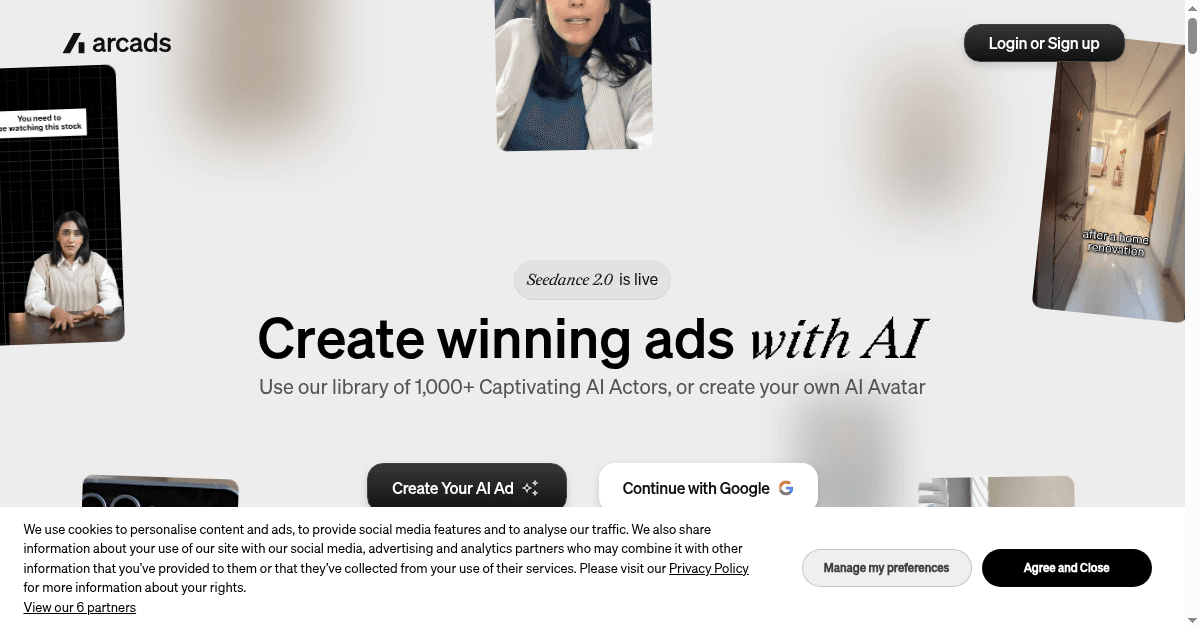
Arcads is an AI-powered video ad creation tool that generates UGC-style video ads using AI actors. You write a script, choose an AI actor, and get a complete video ad in minutes rather than days. It is built for performance marketers and agencies who need high volumes of ad creative at a fraction of traditional production costs.
Score Breakdown
If you run paid social ads at any meaningful scale, you have experienced the creative bottleneck. You find a winning hook, scale the budget, performance plateaus after two to three weeks, and the creative team scrambles to produce new variations. Meanwhile you are watching cost per acquisition climb while waiting for fresh assets.
Real UGC (user-generated content) solves this creatively but not economically. A decent UGC creator charges $150 to $500 per video. To test 10 hooks properly, you are looking at $1,500 to $5,000 in creative production before you know which angle works. For most brands and agencies, that cost per variation is prohibitive.
Arcads is built to fix this. AI actors, your script, minutes to produce, a fraction of the cost. For agencies managing multiple client ad accounts, the volume advantage is especially valuable.
I tested Arcads across three different campaigns for two e-commerce brands and a SaaS product. Here is the honest assessment.
What Arcads Does
Arcads lets you generate video ads using a library of AI actors. You write (or paste) your script, select an AI actor that matches the demographic you want to target, configure a few settings, and the platform generates a complete video: actor delivering your script with natural-looking mouth sync, appropriate background, and optional captions.
The output looks like a person talking directly to camera, which is the format that performs best on TikTok and Meta for most direct response offers. It is not visually identical to a real human performance, but it is convincing enough that most viewers will not scrutinise it closely in a 30-second ad.
The key use case is volume and iteration. Arcads lets you take a winning script and generate multiple variations: different actors, different hooks, different tonality. Or take a single actor and test 15 different scripts. The workflow compresses what would be a multi-day production effort into an afternoon.
The AI Actor Library
Arcads has a library of AI actors covering a range of demographics: different ages, ethnicities, genders, and perceived professional backgrounds. The variety is meaningful. If you are advertising a product aimed at middle-aged women, you can pick an actor who matches that demographic. If your product appeals to young male athletes, you can find something closer to that.
In my testing across 40-plus generations, the diversity of actors was sufficient for all three campaigns I worked on. I never felt constrained by lack of options.
The quality of actor performance varies. The best actors in the library are impressive: natural eye contact, believable expressions, lip sync that holds up to scrutiny. A minority of options have a slightly uncanny quality that I would not use for brand advertising. The solution is to preview before committing to a full script run.
Arcads is adding new actors regularly. The library grows with each product update, which matters as you run more campaigns and want fresh faces for creative refresh.
Script to Video: How It Works in Practice
The production workflow is straightforward. You paste your script, select your actor, choose a background option, configure caption style, and hit generate. For a 30-second script, generation takes roughly two to four minutes.
The speed is genuinely transformative for the way you can approach creative testing. Traditional creative workflow: brief, filming, editing, review, revisions, final delivery. Two to five business days minimum, often more. Arcads workflow: write script, generate, review. 15 minutes from idea to reviewable asset.
For testing hooks specifically, this changes everything. A hook test that would previously cost $3,000 in production and take a week to turn around now costs $30 and takes an hour. That difference in economics allows you to test far more aggressively, kill underperformers faster, and scale winners with confidence.
Lip sync quality is the technical area I looked at most carefully. In the best cases, it is convincing and holds up on a second viewing. In a minority of cases, the synchronisation drifts slightly, particularly on longer words or when the actor turns slightly. For most ad placements where viewers are watching at normal speed, this is not a critical issue. For any placement where viewer scrutiny is high, preview carefully before publishing.
Ad Formats and Platform Compatibility
Arcads generates video in multiple formats: 9:16 for TikTok and Instagram Reels, 1:1 for Instagram Feed, and 16:9 for YouTube pre-roll. You can generate the same script in multiple formats simultaneously which simplifies multi-platform campaign setup.
Meta (Facebook and Instagram) is the primary use case for most users and where Arcads ads perform best in practice. TikTok works well, particularly for products where UGC-style content fits the platform tone naturally.
YouTube pre-roll is a more challenging format for AI actor content. YouTube viewers tend to watch more attentively than passive social scrollers, which means the limitations of AI video are more visible. I would reserve Arcads for Meta and TikTok and use higher-production content for YouTube.
Honest Quality Assessment
You want to know whether these ads actually look real. The honest answer is: close enough for the feed, not quite real under scrutiny.
In a fast-scrolling TikTok or Facebook feed, most Arcads-generated ads are indistinguishable from genuine UGC unless the viewer pauses and examines them. That is the level of fidelity that matters for performance. Viewers who pause to scrutinise your ad are not your target audience anyway.
In side-by-side comparison with genuinely high-quality UGC from a skilled creator, the Arcads version loses. The micro-expressions, the authentic imperfection, the genuine enthusiasm of a real person who loves a product, these are things AI cannot fully replicate yet. A skilled UGC creator with a real connection to your product will outperform Arcads on a truly level playing field.
The economic comparison changes the answer. At $150 to $500 per real UGC video versus $2 to $5 per Arcads video, you can test 50 to 100 Arcads variations for the cost of one real UGC video. The statistical advantage of volume often overcomes the quality gap.
The smart approach is to use Arcads for initial hook testing and variation generation, and commission real UGC from a creator only for proven winning scripts that you plan to scale significantly.
Pricing
Arcads has two main plans. The Starter plan costs $110 per month and the Creator plan costs $220 per month, each including a monthly allocation of video generations. The Creator plan offers higher generation limits and additional features for agencies managing multiple client accounts. Pay-per-generation credits are also available if your volume does not justify a monthly plan.
For an agency running paid social campaigns for multiple clients, the economics are strong. The cost per video at scale is a fraction of real UGC production costs, and the time savings in creative production are significant.
For a brand spending less than $5,000 per month on paid social, the return on a $110/month Arcads subscription may require some thought. At that spend level, creative refresh frequency matters less than at higher budgets.
The free trial gives you enough generation credits to test the quality properly across several scripts and actors before committing.
Arcads vs Competitors
Creatify is Arcads' most direct competitor and the comparison most users consider. Creatify has a strong actor library and similar pricing. In head-to-head testing, the quality difference is marginal. Arcads has a slight edge in actor diversity and the interface is more intuitive. Both are worth trialling before committing.
HeyGen is a broader AI video tool that handles spokesperson videos, presentations, and business use cases beyond ads. It is more expensive and more complex than Arcads. If you need AI video for use cases beyond paid ads (company presentations, investor decks, training videos), HeyGen is worth considering. If your use case is specifically paid social creative, Arcads is better positioned and more cost-effective.
Real UGC creators remain the gold standard for top-performing creative at scale. Platforms like Billo or Minisocial connect brands with real creators for authentic UGC. For your proven winners, commission real UGC. For testing and iteration, use Arcads.
ROI for Paid Social Advertisers
The ROI calculation for Arcads depends on your current creative production workflow.
If you are currently using a creative agency or freelance videographers for ad creative, the comparison is straightforward. If you are paying $2,000 per month for creative production and Arcads lets you generate equivalent volume for $110, the savings are obvious. More importantly, the iteration speed Arcads enables means you can find winning creative faster, which reduces the time you spend at sub-optimal cost per acquisition.
If you are currently bootstrapping with no real creative production budget, Arcads lets you create professional-looking ad content that you simply could not otherwise produce at this price point.
Bottom Line
Arcads delivers on its core promise: UGC-style video ads at a fraction of the cost and time of real UGC production. The quality is good enough for the feed and the economics are transformative for high-volume creative testing.
The free trial is genuinely worth taking. Generate five to ten ads, test them against a real creative in your account, and the data will tell you whether the format works for your specific audience and offer.
For any business running paid social ads at meaningful scale, Arcads belongs in the creative production workflow. Not as a replacement for all real UGC, but as the primary tool for testing and iteration.
Arcads
Pros
- Generate UGC-style video ads in 2-4 minutes vs days for real production
- Cost per video is 50-100x lower than real UGC creator fees
- Diverse actor library covers a wide range of demographics and styles
- Format support for Meta, TikTok, Instagram, and YouTube
- Enables aggressive hook testing that was previously cost-prohibitive
Cons
- Quality does not quite reach real high-quality UGC under close scrutiny
- Some actors in library have uncanny qualities - preview before committing
- Less effective for YouTube where viewer attention is higher
- Support response times need improvement
Our Verdict
RecommendedThe best tool for paid social creative teams who need to test more hooks and iterate faster. Use it for testing, real UGC for scaling proven winners.
Best For
Performance marketers and agencies running Meta and TikTok ads who need high-volume creative testing without high production costs
Not For
Brand campaigns requiring premium production quality or advertisers primarily running YouTube